
 |
British shorthair |
|
TranslationFrancis Vandersteen |
||
OriginThe British shorthair is a breed of cat that originated in Great Britain. |
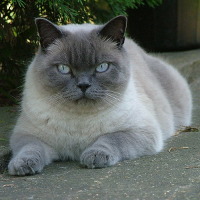
| This medium to large cat is characterized by its very round head and large, round eyes. |
A brief historical overview |
| At the same time, English breeders such as H. Weir selected the most beautiful alley cats, which were exhibited for the first time at London's Crystal Palace in 1871. They were called British shorthair to distinguish them from foreign, oriental and longhaired cats. It is the counterpart of the European shorthair of continental Europe and the American shorthair of the United States. It is likely that British shorthairs were imported into the USA as early as the early 1900s, although they were registered as "domestic shorthair" until the 1950s. The First World War dealt a major blow to British shorthair breeding, which was almost extinct. In order to revive the breed, crosses were made with non-pedigreed cats, resulting in the loss of the breed's typical physique. To give them back their lost roundness, the Persian was used. The GCCF refused to register these crossbred cats as British shorthairs, and it took three generations before the offspring could be registered again. After the Second World War, the same thing happened again. In addition to alley cats, it's likely that crossbreeding with Russian blues, burmeses and chartreux took place. The consequences were the same as after the First World War, and Persians had to be used once again. The longhair gene was thus introduced into the breed. Kittens born with semi-longhair in British shorthair litters were neglected for a long time, but in France, in 2000, the variety was recognized under the name British longhair. In the United States, where it was crossed with American shorthairs, the British shorthair was recognized by the CFA in 1980 and by the TICA in 1979. The latest TICA standard dates from 1993, but has changed little over the years. In France, the LOOF approved it in 1979. |
Health |
| The British shorthair is a fairly robust cat in good health. However, some genetic diseases are present in British shorthairs, so breeding stock is tested, at least by genetic test for PKD (a kidney disease), and possibly by regular heart scan for HCM. |
Head |
||
Cranial region |
||
Head |
The apple-shaped head is often reminiscent of a teddy bear's head. The contours are rounded. | |
Facial region |
||
Nose |
The nose is short, broad and well curved. The nostrils must be wide open, however, as too long a nose will result in show penalties. The British shorthair must not, however, look too much like a Persian or Exotic shorthair with its curved nose, as this would be considered an eliminatory defect in the show ring. | |
Muzzle |
The muzzle is firm and full. | |
Cheeks |
Full cheeks. | |
Eyes |
The eyes are wide open, large and round. They are set far apart (giving the impression that the nose is even wider) and their color should match the cat's coat. Bright, intense eye colors are favored. | |
Ears |
Medium to small in size, the ears are broad at the base and rounded at the tip. Like the eyes, they are set wide apart on the head. | |
Neck |
| The neck is stocky and short, giving the impression that it is non-existent. |
Body |
||
Generality |
The British Shorthair is a round, robust and powerful cat. It has a muscular, semi-cobby body. Lack of muscle tone or fine bones are considered faults. | |
Tail |
| The tail is thick at the base and remains more or less the same thickness throughout its length. The tip is rounded and the length of the tail should equal two-thirds of the body. |
Limbs |
| The legs are of medium to short length, with powerful musculature and bone structure. | ||
Forequarters |
||
Shoulders |
The hips and shoulders are broad, making it relatively imposing. | |
Hindquarters |
Feet |
| Round, firm feet. |
Coat |
||
Coat and texture |
The coat is short and dense with a thick undercoat. The coat is so close that it can be compared to a wool carpet. When the cat turns its head, the hair separates at the neck. In blue, lilac and cream cats, variations in coat texture are permitted. A coat that is too long or lies flat on the body will be penalized, as will a lack of undercoat and density. All coats and colors are recognized. White patches on cats with coats other than particolored will result in elimination at a show, as will ghost markings on solid-colored cats. |
|
Size and weight |
||
Height at withers |
Male height at withers: between 23 and 25 cm. Female height at withers: between 22 and 24 cm. |
|
Weight |
Average adult male weight: between 4 and 8 kg. Average adult female weight: between 4 and 8 kg. |
|
Tolerances |
 Seasonal variations in coat texture are permitted. Texture may differ slightly in cats of colors other than diluted. Seasonal variations in coat texture are permitted. Texture may differ slightly in cats of colors other than diluted. |
Penalties |
| Texture too long or lying flat. Coat lacking undercoat and general density. Flat skull, stop too pronounced, nose too long. Closed hocks. Phantom tabby markings in solid-colored cats, except in the orange series. |
Refusal of any title |
| White patches in other than particolored cats. Appearance too close to Exotic Shorthair or Persian. Pinched nostrils. Delicate bones. Lack of muscle tone. General faults and defects eliminatory in shows. |
Authorized marriages |
| British Shorthair x British Shorthair British Shorthair x British Longhair British Longhair x British Longhair Crosses with British longhair are permitted. Highland fold and Scottish fold crosses are also permitted with this breed, but the kittens will be registered as Highland or Scottish fold and not British shorthair. |
| {flexi_FIELD:historique_race item: method:display} |



 English (United Kingdom)

Comments