
 |
German rex |
|
TranslationFrancis Vandersteen |
||
OriginThe German rex is a breed of cat that originated in East Prussia (now Baltic Russia). |
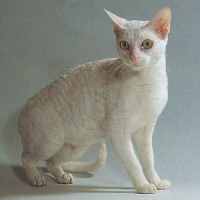
| This medium-sized cat is characterized by its short, wavy and very soft coat. |
A brief historical overview |
| The German rex is thought to be the first breed of cat with curly or wavy hair. The first subject was discovered in the early 1930s by Erna Schneider in Königsberg (now Kaliningrad). She named this cat Kater Munk and it is thought that the parents were a blue Persian mother and a Russian Blue father, although nothing can prove this. In any case, she wore this blue dress herself. It is thought that there were also two males from the same litter, but they were quickly castrated. We don't know if she had kittens, but she died in 1944 or 1945. Later, in 1951, Dr. Rose Scheuer-Karpin spotted a black-and-white curly cat in the garden of the hospital where she worked in Buch (now Pankow). She named her Lämmchen (meaning “little lamb”). She had litters, and it was by crossing her with one of her sons that Dr. Scheuer-Karpin obtained other kittens with wavy, particularly soft hair. This was the start of breeding. Lämmchen died in 1964 or 1967, leaving behind a number of curly-haired and mixed-breed cats. It's not known whether she was related to Kater Munk, but it's thought that she may have been, thanks to the high level of German immigration at the time. Lämmchen descendants were often crossed with Cornish rex to improve the breed, which had skin problems at the time. In 1986, a German cattery bought the last three Lämmchen descendants to prevent the breed's extinction. The breed was recognized by FIFé and LOOF under the name German rex. CFA, on the other hand, associates it with the Cornish rex. The breed is still very rare today, but a few German breeders have been working to develop this cat since 1999. To avoid excessive inbreeding, the breed is interbred with smooth-haired cats. There are now breeders in Russia, Sweden, Finland and the Netherlands. Rose Scheuer-Karpin, considered the breed's founder, still lives in Germany. |
General appearance |
| Unlike other curly-haired breeds such as the Devon rex or Cornish rex, which tend to have a physique close to that of oriental cats, the German rex keeps a physique close to that of the European. |
Head |
||
Cranial region |
||
Head |
The head is longer than it is wide, but still quite round, with clearly visible cheeks. | |
Facial region |
||
Forehead |
The forehead and skull are rounded, and the nose is straight and of medium length. | |
Muzzle |
Strong muzzle. | |
Eyes |
Oval-shaped, set at a slight angle. All colors are accepted as long as they match the coat. | |
Ears |
Broad at the base, with rounded tips. They are of medium size and their outer side should be well covered with fine but dense hair, while the inner side should be sparsely coated. | |
Body |
||
Generality |
Muscular, with broad chest and straight back. | |
Tail |
| Fairly thick, medium length, tapering to the tip. |
Limbs |
Forequarters |
||
Generality |
The legs are of medium length and rather slender, with round paws. | |
Hindquarters |
Coat |
||
Coat and texture |
The coat is characteristic. It is like that of the Cornish rex, but the curls are tighter and denser. It should be short and velvety to the touch, with wave-like curls. The German rex has no guard hairs, and its whiskers are short and curly. All colors are accepted except chocolate, cinnamon, fawn and lilac in traditional patterns (no colorpoint). | |
Size and weight |
Authorized marriages |
| Cross-breeding with European cats is authorized by the LOOF. |



 English (United Kingdom)

Comments