
 |
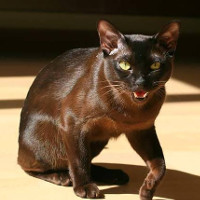
Havana brown |
|
TranslationFrancis Vandersteen |
||
OriginThe Havana brown, also known as the Swiss Mountain cat or Chestnut Oriental Shorthair, is a cat breed originally from Great Britain. |
| This cat is characterized by its chocolate-colored shorthair coat. |
A brief historical overview |
| The ancestors of the Havana brown existed in the kingdom of Siam (now Thailand), probably Burmese or Tonkinese. Their color was appreciated and they were said to ward off evil spirits. Later, in the 19th century and around 1880, several cats with characteristic brown coats were exhibited and enjoyed by the general public, but no further action was taken. It wasn't until 1950 that Baroness Von Ullman, who wanted a chocolate-brown cat, crossed a chocolate-point Siamese with a black European. The kittens born of this union were a success, and other breeders followed suit. In the early days of Siamese breeding, the breed accepted all patterns. In the 1920s, Siamese breeding clubs in Britain decided to concentrate solely on the colorpoint, and other color varieties began to disappear. After the Second World War, breeding programs to introduce chocolate color resulted in the reappearance of the solid pattern. Initially, each new solid color became a new breed: Chestnut brown foreign, with its solid chocolate color, was the first breed recognized by the GCCF in 1958, giving rise to Havana, followed by Lavender, with its solid lilac color, and then Foreign white, with its all-white color. Breeders soon realized that it was unrealistic to continue with the “one color, one breed” model, given the large number of coat colors existing in cats. In the UK, it was decided to split the Siamese breed into several breeds: - Colorpoint cats are Siamese; - Chocolate solids are Chestnut brown foreign or Havana. Imported into the United States, this breed gave rise to Havana brown; - Foreigns represent non-chocolate solid colors and include Foreign white; - Oriental shorthair contains all other colors. The English soon recognized the breed as Havana brown. It's not clear why this name was chosen, perhaps because of the coat of a rabbit of the same name, or because of the color of the famous cigars. The breed was imported to the United States, where it enjoyed great success. From then on, British and American specimens were differentiated. The British developed the Havana Brown into a Siamese type, while the Americans kept the original type. The GCCF recognized the breed as Chestnut Havana Brown and Havana Brown in 1958. The breed remains rare today, especially in Europe. There are around ten breeders worldwide, mainly in the USA and Canada. The American breed was recognized by the LOOF in the late 1990s. Three active breeders were present in Europe in 2011 (2 in France, 1 in Italy). In 2012, 2 more kennels will make their appearance in France. The FIFé recognizes the breed as an Oriental. |
Behavior / characteristics |
| The Havana brown is said to be a curious, lively and playful cat, but one that appreciates the comfort of home. It likes to chat with its owners from time to time. He craves love and affection. He always seeks physical contact with his human companion. |
Head |
||
Cranial region |
||
Head |
The head is longer than it is broad, and well proportioned to the body. | |
Facial region |
||
Forehead |
Flat forehead, slightly rounded skull, pronounced stop. | |
Nose |
The very square nose is characteristic of Havana Browns. | |
Muzzle |
Long, square muzzle with strong chin. | |
Eyes |
Oval, large and wide-open, always green in color and as intense as possible. | |
Ears |
The ears are large and set wide apart, pointing forward. | |
Body |
||
Generality |
Rectangular and well muscled. | |
Tail |
| Medium-length, fairly fine tail. |
Limbs |
| The legs are long and robustly boned, yet elegant. | ||
Forequarters |
Hindquarters |
Feet |
| Oval, compact paws. |
Coat |
||
Coat and texture |
The coat should be soft and silky. Color should be as deep as possible. Only plain cats are accepted, without stripes or white hairs. The only colors allowed are chocolate and lilac, but the latter is only recognized by TICA. Kittens born lilac also have ghost markings during their first year, which gradually disappear. | |
Size and weight |



 English (United Kingdom)

Comments