 |
Standard Ratzer |
|
He is not recognized by the F.C.I. |
Origin |
Germany <> U.S.A. -> U.S.A. | |
Translation |
Francis Vandersteen |
A brief presentation of the Standard Ratzer |
| The Standard Ratzer is a lovely mix of Schnauzer and Rat Terrier. Its size varies a little, since the Rat Terrier comes in two sizes, but it weighs no more than 13.5 kilos and generally stands less than 51 centimeters tall. This breed is an excellent pet that can get along with anyone, provided it is socialized from an early age. The Standard Ratzer has a long lifespan, usually around 18 years, but has been known to live up to 23 years. However, there are a few congenital health problems to watch out for, such as Schnauzer comedo syndrome and porto-systemic shunt. |
History of the Standard Ratzer |
| To get an idea of your Standard Ratzer's history, you need to look at the history of the Schnauzer and the Rat Terrier. |
A little of the Schnauzer |
||
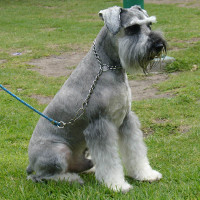
| The Schnauzer was developed as a vermin hunter. Originating in Germany in the Middle Ages, the breed was perfected from the wolf Spitz, Poodle, Pinscher and Schnauzer. According to some, a work by Albrecht Durer depicts the Schnauzer in the 15th century. However, they weren't really noticed until the 1800s, when breeding programs were developed to produce the Schnauzer standard. The American Kennel Club recognized the breed in 1904, and the Schnauzer is the 85th most popular dog in the USA. | ||
 |
||
| Standard of the Schnauzer |
A little of the Rat Terrier |
| The Rat Terrier is an American breed that was developed in the 1800s as a vermin hunter. It is thought to be descended from Beagles, Greyhounds and Whippets, as well as various types of European Terriers and Fox Terriers. There are two sizes, the miniature Rat Terrier and the standard Rat Terrier. The Miniature Rat Terrier weighs only around 4.5 kilos, while the Standard can reach 11.5 kilos. The combination of these breeds has given the Rat Terrier a wonderful personality, speed, athleticism and great sniffing ability. In the 1900s, the Rat Terrier was the most common farm dog in the United States. In fact, they were so popular that President Roosevelt owned several when he was in the White House, known as Teddy Terriers. The American Kennel Club recognized the Rat Terrier in 2013 and it is the 96th most common dog breed in the United States. |
 |
| Presentation of the Rat Terrier |
Appearance of the Standard Ratzer |
| Although most dogs have brown eyes, the Standard Ratzer can have just about any shade of eyes, which can be amber, blue, green, hazel or brown. This hybrid has a very cute facial structure, with a serious expression and bushy eyebrows. Its brown or black nose is broad, with large nostrils on a square muzzle with a slight overbite and black lips. They can be small to medium-sized, with medium-length, wiry coats of tan, chocolate, liver, salt-and-pepper, orange, yellow, black, brindle, sand, merle, magpie, red, white or silver. It has V-shaped ears that can be perky or pendulous, a rounded head, long legs and a rectangular body with a straight tail. |
Temperament of the Standard Ratzer |
| This lively breed loves to play and be the center of attention. It's also an excellent watchdog that will warn you of any threat. The Standard Ratzer is an adorable breed, but needs to be supervised in the presence of young children and small animals. They are easy to train and quick learners, so you shouldn't have any training problems. However, some dogs are stubborn and may require a little more time and patience. Your Standard Ratzer is highly intelligent and can learn to do just about anything you want to teach him if you have the time and patience. |
Needs and activities of the Standard Ratzer |
| All dogs need at least half an hour to an hour of exercise a day to stay healthy and happy. The Standard Ratzer has a moderate activity level, as the Schnauzer has a low to medium energy level, while the Rat Terrier is full of drive and vitality. Your dog should be satisfied with about an hour's playtime, preferably outdoors. If you have a fenced-in yard, you can let him run around outside for a few hours a day under supervision, or take him for a walk around the neighborhood. Your dog may also enjoy playing ball, going to a dog park, swimming, taking agility and obedience classes, and playing flyball. |
Maintenance of the Standard Ratzer |
| Your Standard Ratzer needs careful grooming almost every day to prevent it from shedding too much and to keep its coat healthy and shiny. You should use a high-quality bristle or wire brush and a detangling tool to prevent your dog's fur from tangling. You can also use a detangling tool to prevent excessive shedding. You may need to pluck the coat every two or three months, which involves removing dead hairs by hand or with a plucking blade. In addition, your dog will need his ears cleaned once a month, and his nails trimmed if necessary. His teeth and gums will be healthier if you brush them daily. |



 English (United Kingdom)

Comments