 |
Worgi |
|
He is not recognized by the F.C.I. |
Origin |
Great Britain -> U.S.A. | |
Translation |
Francis Vandersteen |
A brief presentation of the Worgi |
| The Worgi is a hybrid of a Welsh Shepherd Dog and a Welsh Corgi Pembroke. They are medium-sized dogs weighing between 9 and 14 kilos and measuring between 25.5 and 38 centimeters. Their coat is abundant, silky, straight and of medium length. The coat can be brown, fawn, white or black, but is most often multicolored. These are highly intelligent dogs that always use their brains and are easy to train. They are excellent with children and other dogs. Worgis are very active and need a good dose of daily activity to stay healthy and happy. |
History of the Worgi |
| The Worgi is a mixed breed that results from crossing a Welsh Shepherd Dog with a Welsh Corgi Pembroke. |
A little of the Welsh Shepherd Dog |
||
| The Welsh Shepherd Dog, also known as the Welsh Collie, first appeared in the 19th century. This breed is the result of crossing working Collies with native Welsh dogs. Other than that, little is known about the breed's origins. It is thought that the breed is related to the Gellgi or hidden hunting dogs, and that Welsh Shepherd Dog are the result of a cross between a black and tan sheepdog and a Border Collie. Welsh Collies have been crossed with so many other Collies that they have practically disappeared. There was only one way to determine whether a dog was a true Welsh Sheepdog: the way it worked the sheep, as this differed from that of the Border Collie. In 1997, the Welsh Sheepdog Society was founded, with the aim of preserving the breed. The Welsh Shepherd Dog is not registered with the American Kennel Club. | ||
 |
||
| Presentation of the Welsh Shepherd Dog |
A little of the Welsh Corgi Pembroke |
| The Corgi originated in Pembrokeshire, Wales. The Corgi's obscure past has given rise to a number of myths. A Welsh legend has it that the Corgi came from the lairs of fairies and elves. One day, two children found some Corgi puppies. They thought they were foxes, but they saw something strange in them and decided to take the puppies with them. Their parents realized they were dogs and took them as a gift from the fairies. The dogs became loving pets and helped herd cattle. Apart from this legend, the Welsh Corgi Pembroke is thought to be descended from the Vallhund, a Swedish dog that was used to herd cattle. Vallhunds arrived in Wales with the Vikings in the 9th and 10th centuries. Another common belief is that the Corgi comes from dogs that belonged to Flemish weavers, and were brought to Wales in the 12th century. The United Kennel Club recognized the Corgi in the 1920s. Then, in 1934, the breed was divided into two categories: the Pembroke and the Cardigan. The Welsh Corgi Pembroke was recognized by the American Kennel Club in 1934. It's well known that Queen Elizabeth II is a true fan of the breed; she received her first Corgi in 1933 as a gift from her father. |
 |
| Standard of the Welsh Corgi Pembroke |
Appearance of the Worgi |
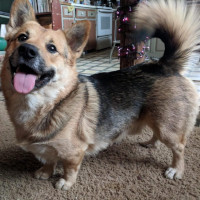
| Worgis are medium-sized dogs, with short legs and a longer body. Their tails are long and hairy. They have a medium-length silky coat, which can be white, brown, fawn, chocolate, black, and is usually a combination of colors. Their ears are triangular and generally erect, but can sometimes fold back at the tip. Their head is fairly broad and flat at the top, with a narrower muzzle that should meet in a scissor bite. They have soft, intelligent, rounded eyes and a black nose. Their legs tend to be feathered, as do their tail, ears and chest. Their lips and eyes are trimmed in black. |
Temperament of the Worgi |
| The Worgi is a lively, friendly and gentle dog. He's certainly very intelligent, always using his wits and usually one step ahead of his master. He's perfect with children, as he's very gentle and tolerant, and gets on very well with other dogs and animals. They are very easy to train, as they are very intelligent and like to follow orders. These dogs are always ready to play, and they also love to run and swim. They like to keep busy and are not really lapdogs. It's important to socialize your Worgi from an early age to prevent it from becoming shy in adulthood. They are also quite noisy and will bark if intruded upon. |
Needs and activities of the Worgi |
| This dog is designed for active people. As both its parents are working dogs, the Worgi has a lot of energy to expend. Two daily walks lasting 30 to 45 minutes will help him conserve his energy. In addition, he'll need playtime or time to run around off-leash in a park or yard. These dogs love to play games such as fetch, tug-of-war, and even soccer or Frisbee. They also enjoy swimming. What's more, these dogs are highly intelligent and need mental stimulation to avoid boredom. Highly stimulating toys, such as a puzzle, are very welcome. The Worgi adapts well to life in an apartment, but you'll need to take it outside every day for some good exercise. |
Maintenance of the Worgi |
| Worgis shed moderately, but may shed more during the usual seasons, usually spring and autumn. The hair is medium-length, silky and straight, making it easy to clean. You can use a damp towel or wipe to remove dirt. Bathe him only when necessary to avoid drying out his skin. Brush him every week, using a smoothing brush or a pimpled brush, to remove loose hair. Clean his ears every week, using an ear cleaning solution and absorbent cotton. Trim his nails once or twice a month, depending on how worn they are. Brush his teeth at least two or three times a week to remove tartar deposits and bad breath. Occasionally, you may need to trim the hair around his eyes, ears and paws to prevent infections and blockages. |



 English (United Kingdom)

Comments