Pitsky

He is not recognized by the F.C.I.

Origin
U.S.A. <> Siberia -> U.S.A.
Translation
Francis Vandersteen

A brief presentation of the Pitsky

A beautiful cross between the American Pit Bull Terrier and the Siberian or Alaskan Husky, the Pitsky is a new hybrid dog breed that has grown in numbers in recent years. Breed enthusiasts admire this attractive dog for its enthusiastic personality and affectionate nature. Incredibly intelligent, the Pitsky requires an experienced trainer and should receive plenty of mental and physical stimulation to stay on track. They are loyal to their families and can become overly attached, which should be avoided at an early age to prevent separation anxiety.

History of the Pitsky

The Pitsky is a cross between the much-loved American Pit Bull Terrier and the Siberian Husky or, more rarely, the Alaskan Husky. Although the Pitsky has probably only been around for a few decades, its ancestors have a much longer history.
        

A little of the American Pit Bull Terrier

        
The American Pit Bull Terrier is descended from the British Bull and Terrier breeds, exported to the United States in the late 19th century. Traditionally, these dogs were used for bull-baiting and dog-fighting, but they soon acquired a reputation as respectable farmers' dogs and wonderful pets. The Siberian Husky has a long history, dating back thousands of years. While they originated in the Arctic, where they were kept as pack dogs, they gradually made their way south to Alaska and Canada, and then to America. They were traditionally used as sled dogs and would have helped people hunt. Today, they are recognized as an alert, intelligent pet.
Presentation of the American Pit Bull Terrier

A little of the Siberian Husky

Alaskan Huskies differ from Siberian Huskies in that they are not recognized as a true breed and are seen more as a type of Husky. They tend to be leaner and lighter than Siberian Huskies, although they are otherwise very similar. As there is no breed standard for the Alaskan Husky, and breeds such as the German Shorthaired Pointer and German Greyhound have been mixed into the line, their physical appearance can vary widely.
Standard of the Siberian Husky

Appearance of the Pitsky

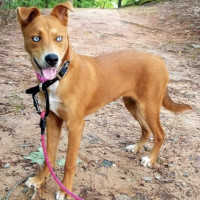
Hybrid dogs, especially those that haven't been around very long, can vary enormously in appearance from litter to litter. This is especially true for the Pitsky if the mix includes the Alaskan Husky, which is a breed with an already highly varied physical appearance. Developed from two naturally athletic breeds, it was inevitable that the Pitsky would have a strong, muscular body. Although the Husky and Pit bull are athletes in their own right, they were bred for very different purposes and have totally different body shapes. First-generation Pitskys may take more after their lean, long-limbed Husky parent, or they may look more like the sturdy, stocky Pit-bull. Ears can be erect, droopy or somewhere in between. Although their eyes are the popular piercing blue color associated with Huskies, they can also be brown or green, and it's not uncommon to have one eye colored differently (heterochromia). The tail within this breed is particularly variable, with some puppies having a long-haired, spiny tail that curves over the back and others having a low, less erect tail. The Pitsky's coat can be a single or double coat, and there is a wide range of potential coat colors, including black, white, red, gray, fawn and brindle. A mixture of a few color combinations is frequently seen, and there are an almost unlimited number of possible patterns and markings. Males generally measure between 43 and 56 centimeters, while smaller females measure between 40 and 53 centimeters. Males weigh between 22 and 29 kilos, and females are usually a few kilos lighter, between 20 and 27 kilos.

Temperament of the Pitsky

A dog with energy to spare, Pitskies don't tend to have a Stop button. A breed that would happily run 10 km before joining you for a game of soccer, the Pitsky is ideally suited to a very active family who can provide them with plenty of space and outdoor access. Loving and affectionate, Pitskies tend to bond closely with their families and will get on well with children at home as long as they've been introduced to them from an early age. Of course, with such a powerful dog, young children will need constant supervision and must learn to respect the family dog. The close bonds these dogs form with their family members can pose a problem for some dogs who become too attached. Pitskies should not be housed where they will be left alone for long periods. Some Pitsky dogs can be very tense and hyper tense and will need solid training to stay on track. When it comes to mixing with other animals, caution is recommended. Dog-to-dog aggression is a possibility, especially with two undisturbed males. Similarly, smaller pets are at risk, as the Pitsky has a strong prey drive.

Needs and activities of the Pitsky

The Pitsky cross is a very athletic animal and requires plenty of exercise every day, usually at least an hour and a half of vigorous or strength-building exercise, although most prefer two hours or more. Goblins that don't get enough daily exercise and attention can become both destructive and vocal, sometimes even howling in frustration. Fortunately, these high-energy dogs also possess many talents and can enjoy and even excel at many types of activity. In addition to long walks, jogging and running, these dogs can also enjoy sports such as Frisbee competitions, sled shooting or skijoring and agility training.

Maintenance of the Pitsky

Grooming requirements for this dog will vary according to the coat characteristics it may have inherited. Bathing may be infrequent with either coat, but if your dog has inherited the Husky's thick undercoat, it's particularly important to ensure that this layer is completely dry to prevent mold growth. Both coats require regular brushing, but the longer coat, like that of the Husky, will require more frequent brushing, usually daily, while the shorter coat of the Pit Bull can be treated with weekly brushing. This hybrid will shed quite heavily, although short-haired dogs may shed more moderately than long-haired ones.

Comments

Latest page updates

  • Telomian

    Telomian He is not recognized by the F.C.I. Origin Malaysia Translation Francis Vandersteen A brief presentation of the Telomian The Telomian is a very rare breed of dog, and the only one native to Malaysia to have been bred outside the country. They were originally bred by the indigenous people of Malaysia to combat parasites such as snakes, rats,...
  • King Wheaten -- Cavalier King Charles Spaniel X Irish Soft Coated Wheaten Terrier

    King Wheaten He is not recognized by the F.C.I. Origin Great Britain <> Ireland -> U.S.A. Translation Francis Vandersteen A brief presentation of the King Wheaten The King Wheaten is a small dog with a heart this big and a playful disposition. Borrowing the energy and soft-coated waves of the Irish Soft Coated Wheaten Terrier and the size and...
  • Spanierd -- English Springer Spaniel X German Shepherd

    Spanierd He is not recognized by the F.C.I. Origin Great Britain <> Germany -> U.S.A. Translation Francis Vandersteen A brief presentation of the Spanierd The Spanierd is a hybrid dog. Its parent breeds are the English Springer Spaniel and the German Shepherd. They have an affable personality. He's known for entertaining family and friends with his...
  • Alaskan Goldenmute -- Alaskan Malamute X Golden Retriever

    Alaskan Goldenmute He is not recognized by the F.C.I. Origin U.S.A. <> Great Britain -> U.S.A. Translation Francis Vandersteen This breed is also known as Alaskan GoldenGoldenmuteAlaskan Gold Retriever     A brief presentation of the Alaskan Goldenmute The Alaskan Goldenmute is a descendant of two great dog breeds: the Alaskan Malamute and the Golden...
  • French pointing dog Pyrenean type

    French pointing dog Pyrenean type FCI standard Nº 134 Origin France Translation Mrs. Peggy Davis Group Group 7 Pointing Dogs Section Section 1.1 Continental Pointing Dogs « Braque » Type Working With working trial Acceptance on a definitive basis by the FCI Tuesday 18 January 1955 Publication of the official valid standard Tuesday 01 August 2023 Last...
  • French pointing dog Gascogne type

    French pointing dog Gascogne type FCI standard Nº 133 Origin France Translation Mrs. Peggy Davis Group Group 7 Pointing Dogs Section Section 1.1 Continental Pointing Dogs « Braque » Type Working With working trial Acceptance on a definitive basis by the FCI Monday 17 January 1955 Publication of the official valid standard Tuesday 01 August 2023 Last...
  • Vucciriscu

    Vucciriscu He is not recognized by the F.C.I. Origin Sicily Translation Francis Vandersteen En français, cette race se dit Vucciriscu Diese Norm ist in deutscher Sprache sichtbar Vucciriscu En español, esta raza se dice Vucciriscu In het Nederlands, wordt dit ras gezegd Vucciriscu This breed is also known as Sicilian Vucciriscu Sicilian Butcher...

© 2026 Groupe Milouchouchou ASBL. Tous droits réservés. En savoir plus

Protected by Copyright01
We use cookies

We use cookies on our website. Some of them are essential for the operation of the site, while others help us to improve this site and the user experience (tracking cookies). You can decide for yourself whether you want to allow cookies or not. Please note that if you reject them, you may not be able to use all the functionalities of the site.

Ok