 |
Pitweiler |
|
He is not recognized by the F.C.I. |
Origin |
U.S.A. <> Germany -> U.S.A. | |
Translation |
Francis Vandersteen | |
This breed is also known as |
Rottbull
|
A brief presentation of the Pitweiler |
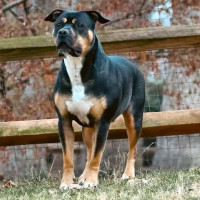
| The Pitweiler is a fairly popular designer dog, a deliberate cross between the American Pit Bull Terrier, a muscular medium-sized dog recognized by the United Kennel Club in England, and the Rottweiler, a very large German dog well known for its guarding ability. The result is a medium to large dog with a lively mind, well-honed protective instincts and a slightly stubborn streak, which tends to mask the fact that, deep down, these dogs are generally extremely sensitive and affectionate with their families. These dogs are relatively active and need at least an hour's exercise a day to maintain their fitness, but their grooming needs are generally undemanding. |
History of the Pitweiler |
| The Pitweiler is a designer dog, an intentional cross between two extremely muscular and determined molosser-type dogs, the American Pit Bull Terrier and the Rottweiler. |
A little of the American Pit Bull Terrier |
||
| The “Pit” in Pitweiler refers to the American Pit Bull Terrier, a dog breed recognized by the United Kennel Club in England, but not yet by the American Kennel Club. The American Kennel Club does, however, recognize the American Staffordshire Terrier, and some dogs are dual-registered as American Pit Bulls in England, but as American Staffordshire in the USA. Although these breeds are virtually identical, the American Pit Bull Terrier shows greater variation in size and color than the American Staffordshire. The prevailing theory concerning the origin of the Pit Bull is that Bulldogs were bred with Terriers in the 1800s to make them smaller and more agile for pit fighting. Selective breeding since the late 1800s has changed the shape of the English Bulldog considerably, encouraging stockier, short-faced dogs with low to the ground bodies, and some experts claim that the Pit Bull Terrier is, for the most part, a smaller delineation of the Bulldogs of the 1800s, used to bait, guard and control bulls, with very little contribution from Terrier-type dogs. | ||
 |
||
| Presentation of the American Pit Bull Terrier | ||
A little of the Rottweiler |
||
| The Rottweiler was developed in the German town of Rottweil from large Roman dogs known as Drover dogs, which were used to drive cattle for butchers and breeders as early as 700 AD. The need for cattle driving declined in the mid-1800s, as cattle could now be transported by train, and the Rottweiler population dwindled considerably. The 1900s saw a resurgence in their popularity as they began to be regarded as high-quality security, police or military dogs, as well as personal guard dogs. | ||
 |
||
| Standard of the Rottweiler |
Appearance of the Pitweiler |
| The Pitweiler is a large to very large dog, weighing between 29.5 and 45.5 kilos, with a robust square build, deep chest and well-defined musculature. The head of this hybrid will be both broad and deep, with strong jaws and a straight, broad muzzle that's slightly shorter than average. Their eyes are generally dark brown and can be round or almond-shaped, and the uncropped ears are triangular and can either fold to the sides to frame the face, or sit higher on the head and fold forward or to the sides. They have a short, glossy coat that can be single-layered like the American Pit Bull Terrier or double-layered like the Rottweiler, and can be available in a variety of colors and patterns. Neither the Rottweiler nor the American Pit Bull is prone to developing the loose skin you see on many other molosser-type breeds, and although Rottweilers sometimes develop wrinkles around the facial area, this is rarely the case with the Pitweiler. |
Temperament of the Pitweiler |
| The well-bred and well-socialized Pitweiler should be a courageous and loyal companion, with great affection for family members. Despite their difficult reputation, these dogs are extremely sensitive and can be prone to separation anxiety if left alone for too long. They are generally very patient with children, young and old, but because of their great power and strength, all interactions with children must be closely supervised, especially with high-energy adolescent animals. Unpredictable behavior is more likely to occur when several dogs are involved than when interacting with individual dogs, especially as this hybrid can be prone to dog-on-dog aggression, and children must learn to be particularly careful around the hips of these dogs as they may be prone to hip dysplasia. Training and socialization should start early for this crossbreed as they may be more prone to dominant behaviors than other dogs, and the genetic background of this animal should be studied closely if possible due to certain lines of Rottweilers and American Pit Bull Terriers that tend to produce dogs that are more anxious, fearful or aggressive than other dogs. |
Needs and activities of the Pitweiler |
| This dog will need around an hour of vigorous exercise a day to maintain its muscular physique, although it generally responds better if divided into two or three exercise sessions a day. Some owners of muscular dogs like the Pitweiler use weight vests to help build or maintain muscle or to reign in over-exuberant behavior, however, a veterinary professional should be consulted before making a change like this to ensure that joints are developed and robust and sufficient to support the extra weight. This crossbreed can also benefit from alternative activities such as breeding events, rally events and even canine freestyle dance competitions. |
Maintenance of the Pitweiler |
| Regular grooming requirements for this dog are generally quite manageable, bathing is only necessary a few times a year and weekly brushing sessions will usually suffice to keep this hybrid's coat shiny and shedding under control. Pitweilers that inherit the Rottweiler's thicker double coat may need extra brushing sessions in spring and autumn, when they shed more than usual. It's crucial to keep an eye on this dog's skin during his regular grooming routine, as he may be more susceptible to certain skin disorders such as atopy or demodectic mange than other dogs. |



 English (United Kingdom)

Comments