 |
Yoranian |
|
He is not recognized by the F.C.I. |
Origin |
Germany <> Great Britain -> U.S.A. | |
Translation |
Francis Vandersteen | |
This breed is also known as |
Yorkie Pom |
A brief presentation of the Yoranian |
| Yoranian is a hybrid blend. It is often referred to as the Yorkie Pom. This little dog measures just 15 to 25.5 centimeters at the shoulders and weighs 1.5 to 3 kilos. Despite its small size, this little dog is well built and robust. Unlike many small dogs, they tend to get on well with children, even if they must always be supervised. He's a happy dog who bonds very closely to his master. This lively little Terrier doesn't know he's a small dog. He has the attitude of a big dog in a small dog wrapper. This breed is often owned and loved by the elderly. |
History of the Yoranian |
| The Yoranian was probably first bred in the 1990s in the USA, but no breeder has been credited with developing the cross. By crossing the gentle, affectionate Yorkshire Terrier with the energetic, playful Spitz Toy / Pomeranian, breeders created a dog that would hopefully reflect a combination of the best characteristics of both parent breeds. In fact, the Yoranian tends to be less assertive and strong-willed than the Spitz Toy / Pomeranian parent, while retaining its liveliness and curiosity. Likewise, Yoranians are gentle and loving like Yorkshires, without the flippant, feigned personality that sometimes curses the parent breed. |
A little of the German Toy Spitz / Pomeranian |
||
| The Spitz Toy / Pomeranian is a small dog descended from a much larger Spitz-type dog. Spitz dogs have been bred in harsh Arctic conditions. Despite its small size, the Spitz Toy / Pomeranian shares the robust personality of its much larger ancestors. It's thought that this fluffy dog owes its name to a place called Pomerania, located in the northern region of Germany and Poland. The breed's origins date back to 1764. In the late 1700s, members of the British royal family brought two of these little dogs, Mercury and Phoebe, to England. Over time, the breed became very popular throughout the UK. In 1912, two Spitz Toy / Pomeranians embarked on the fateful voyage of the Titanic. When the ship sank, they were lucky to survive. The Spitz Toy / Pomeranian breed was recognized by the American Kennel Club in 1900 and entered in the companion dog group. | ||
 |
||
| Standard of the German Toy Spitz / Pomeranian | ||
A little of the Yorkshire Terrier |
||
| The little Yorkshire Terrier has a great fearless attitude. It was bred over 100 years ago to hunt rodents in the mines around Yorkshire, England. It also became a popular dog for hunting foxes and badgers, as it could easily penetrate the prey's den. The Yorkie was originally known as the Broken Haired Scotch, but in 1874 the breed name was changed to Yorkshire Terrier. In the latter part of the 1800s, Yorkies began to be imported into the United States. In 1878, the American Kennel Club officially recognized the breed. | ||
 |
||
| Standard of the Yorkshire Terrier |
Appearance of the Yoranian |
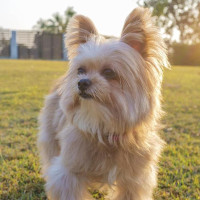
| Yoranians are cream to apricot in color. Its coat is a little rough, giving it a scruffy appearance. His ears are erect, giving him an alert look. The little fellow's eyes are generally dark and his little button nose is black. The Yoranian's tail is small and tends to curl over its back in a sort of inverted position. Its small face is very similar to that of the Pomeranian, with a delicate muzzle. This cute hybrid knows where it's going and has a gait that shows it. |
Temperament of the Yoranian |
| The Yoranian is a fearless little character who adores his masters but is a little wary of strangers. They can often become overprotective if not sufficiently socialized. Unlike many small dogs, Yoranians tend to get on well with children when raised in their company. Interaction must be supervised, however, as he can injure himself if handled roughly or incorrectly. He also appreciates other dogs and cats. Care should be taken when introducing him to small animals, such as hamsters, as his Terrier prey instinct may kick in. |
Needs and activities of the Yoranian |
| A daily walk is usually enough for the Yoranian. He tends to be a rambunctious little fellow who loves to wander and play with his toys. It's a good idea to keep toys, especially chew toys, on hand to keep the little guy occupied. An afternoon at a dog park is often ideal to keep this little fellow happy, as he can run around and interact with other dogs. He's very intelligent, can be taught tricks easily and excels at obedience. When it's cold, make sure you dress him properly and don't leave him outside for too long. |
Maintenance of the Yoranian |
| The Yoranian sheds, but not excessively. In general, daily brushing is sufficient to remove shed hairs and prevent matting. He doesn't need regular grooming. Many owners brush their dog's teeth several times a week to prevent plaque build-up, which can lead to gum disease and eventual tooth loss. This small dog is usually very active, so he often wears his nails to a manageable length. However, if he doesn't naturally keep his nails short, you'll need to trim them monthly. His upright ears generally stay clean, but if debris accumulates inside the ear flaps, you can quickly wipe them clean with a cloth. |



 English (United Kingdom)

Comments