 |
Yorkie Russell |
|
He is not recognized by the F.C.I. |
Origin |
Great Britain <> Australia -> U.S.A. | |
Translation |
Francis Vandersteen |
A brief presentation of the Yorkie Russell |
| A lively mix of two of England's oldest working Terriers, the Yorkshire Terrier and the Jack Russell Terrier, the Yorkie Russell is an energetic little dog with a big personality. They are gentle, affectionate dogs with a playful attitude, constantly seeking their owners' attention. Although only 38 centimeters long, this little dog doesn't hesitate to explore, as his Terrier nature often makes him courageous and curious, which can also get him into trouble. Despite their intelligence and problem-solving skills, they are quite stubborn, making training them sometimes difficult. They have a reputation for being very energetic and, if they don't have a physical or mental outlet, they can become destructive and noisy, as they are often content to be guard dogs, even if this task is not entrusted to them. Although these behaviors can become annoying, with proper attention, training and exercise, they can be exceptional companions in a wide variety of life situations. |
History of the Yorkie Russell |
| While the recently conceived hybrid has little place in terms of chronology, both parent breeds are well established in English history as working dogs. |
A little of the Yorkshire Terrier |
||
| The Industrial Revolution brought many Scottish immigrants to England in search of work, and with them came several breeds of Terrier. Although it is thought that the Yorkshire Terrier developed by mixing these varied breeds such as the Paisley, Tan Toy, Black English and Skye, there is little documented evidence to prove their exact lineage, since most breeding was carried out by factory workers whose sole aim was to produce a dog to keep the vermin population as low as possible. In the late 1860s, a popular show dog appeared, named Huddersfield Ben, sparking enthusiasm for the breed thanks to his refined features. In the years that followed, he became a famous stallion, earning himself the title of father of the breed, and is still known as such today. It was during the Victorian era that Americans discovered the Yorkshire Terrier, adopting both the breed and Victorian customs. Its popularity plummeted again in the 1940s, but during the war, a famous war dog named Smoky rekindled enthusiasm for the breed and has taken its popularity into the top 10 in recent years. | ||
 |
||
| Standard of the Yorkshire Terrier | ||
A little of the Jack Russell Terrier |
||
| As with the Yorkshire Terrier, much of the Jack Russell Terrier's lineage can be traced back to a dog, Trump, whose owner, the Reverend John Russell, was a clergyman and hunting enthusiast who bought him from a local milkman in 1819. At the time, Trump was simply called a Fox Terrier, a general term for any hunting Terrier used to drive foxes out of their holes. He was almost pure white with touches of tan on his face and at the base of his tail, the perfect coloring to help distinguish hunter from prey. Coupled with stamina, courage and a perfectly tempered aggression that never resulted in the unsporting outcome of bitten prey, Trump was the ideal dog to refine the breed in its early years. Although Russell himself went through many dogs due to financial problems, which blurred the clarity of the breed's lineage, Trump is still held in high esteem as one of the breed's characteristic stallions. Russell's own name was eventually attributed to the breed for his work, which was confirmed by two other Englishmen who knew Russell and probably received at least some of his dogs before his death. They formed the Parson Jack Russell Terrier Club and it is thought that their focus on hunting badgers rather than foxes led to the addition of Bull Terriers to the lineage. After the Second World War, demand for hunting dogs plummeted, but the public's desire for them only grew as companion dogs, which was met by crossing breeds such as Welsh Corgis and Chihuahuas, then known as Shortie Jacks and Russell Terriers. In 1976, the Jack Russell Terrier Club of America was formed, finally limiting breeding lines to what we know today. | ||
 |
||
| Standard of the Jack Russell Terrier |
Appearance of the Yorkie Russell |
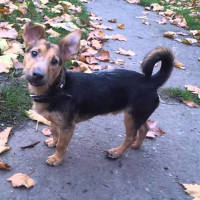
| The Yorkie Russell is a small, lightweight dog, generally measuring less than 38 centimeters and weighing less than 9 kilos. They can sport a variety of coats that are most often long and can be straight or wire-haired, in a wide variety of colors, including combinations of black, white, tan and even silver and blue. They have a short to medium muzzle, a black nose and elongated whiskers and eyebrows. Their eyes are round and marbled, and they generally have a rather lively expression. Their ears are usually erect or folded back, and the same long hair sticks out everywhere, completing their unkempt appearance. Their posture is square, leaning slightly forward, they are longer than they are tall, their legs and chest are well muscled, and their tail is generally straight and of medium length. |
Temperament of the Yorkie Russell |
| On the whole, Yorkie Russels are bright, happy, affectionate and intelligent dogs with a playful attitude. More than anything else, they love attention, which of course can be good or bad. If they don't get enough, they tend to become destructive or engage in undesirable behavior, such as excessive barking. Thanks to their Jack Russell Terrier lineage, they are also very energetic dogs who need a little exercise to stay happy, healthy and positively behaved. Although they are generally accepting of most people and other dogs, they are a little more wary of young children, so great care should be taken when young children are around. Yorkie Russells, like their two parent breeds, are also highly intelligent problem-solvers, and are often stubborn and obstinate as a result. A combination of training, exercise and mentally stimulating play is therefore highly recommended to keep them at their best. Given their affectionate nature, with the right amount of love, training and attention, they make excellent family dogs that adapt relatively well to a wide variety of family situations. |
Needs and activities of the Yorkie Russell |
| For its size, the Yorkie Russell is a moderately energetic dog that needs frequent exercise, attention and interesting games to keep it happy. They enjoy long walks and wide-open spaces where they can run around to expend their excess energy. If properly socialized, they are prime candidates for playing ball at the dog park. Physically, they need around 10 to 15 kilometers of walking a week if possible, plus 45 minutes of playtime a day to stay happy and healthy. As they are a very lively breed, providing them with toys to spoil and mentally stimulating games will also help reduce their tendency to become restless. |
Maintenance of the Yorkie Russell |
| With the coat types that this hybrid breed can have, it's fair to say that there's a whole range of maintenance required, mainly based on the length and density of the dog's coat. In general, at least some maintenance will be needed, as longer coats require regular brushing, at least several times a week, to keep everything clean and healthy. A few brushings a week with a pimpled brush and a comb should suffice. Bathing is generally left to the owner's discretion and the characteristics of the dog's coat, but should still take place every few weeks. It involves washing the dog with a dog-specific shampoo and conditioner if possible, as conditioners can soften the coat and make it more comfortable for the dog and easier for the owner to manage. Depending on length, the coat should also be trimmed, not only to reduce the amount of overall maintenance, but also to enable the dog to function normally, allowing him to have a good field of vision and well-trimmed feet. Folded ears will also need to be monitored, as excess moisture can cause an unwanted build-up of bacteria, so owners will want to check them regularly for any changes. Everything else is pretty standard, including regular brushing of teeth at least once a week and nail trimming if necessary. |



 English (United Kingdom)

Comments