 |
Affenchon |
|
He is not recognized by the F.C.I. |
Origin |
Germany <> France / Belgium -> U.S.A. | |
Translation |
Francis Vandersteen |
A brief presentation of the Affenchon |
| The Affenchon is a cross between the Affenpinscher and the Bichon Frise. Both dogs are small and don't shed much, so your Affenchon will be the same. Other characteristics this dog will probably develop from the parent breeds are a tendency to bark and the need for early socialization. As both parent breeds require regular trimming, be prepared to learn how to keep your Affenchon trim and elegant. This hybrid dog is known to get along well with other pets, but can be wary or shy around strangers. They can adapt to any environment, as long as it's not too hot. Because they are so small and fragile, these dogs should ideally be kept in a home where there are no small children, as they could accidentally injure themselves. |
History of the Affenchon |
| As the Affenchon is a very modern breed, documentation on its history is limited. Always agile and spirited, the characteristics of the Bichon Frise combined with the working dog personality of the old Affenpinscher make it an excellent addition to the family. |
A little of the Affenpinscher |
||
| The Affenpinscher is a breed that originated in Germany, and was first pictured in domestic life as early as the 1500s. The Affenpinscher is one of the oldest known dog breeds and, although the exact year of origin is unknown, history tells us that these dogs were bred and used as farm dogs and rat-hunters way back when. They became pets in the 18th and 19th centuries, and in modern times, the Affenpinscher is still an excellent companion dog, with rat-hunting and surveillance skills. The Affenpinscher is an ancestor of the Griffon Bruxellois and the Griffon Belge. | ||
 |
||
| Standard of the Affenpinscher | ||
A little of the Bichon frise |
||
| The origins of the Bichon Frise date back to the 13th century. Spanish sailors discovered these cute little dogs and brought them all over the world, where they became popular pets and were also appreciated in the French royal courts. This breed is a relative of the Maltese and is known to have been a favorite of all social classes, from ancient royalty to World War I servicemen. | ||
 |
||
| Standard of the Bichon frise |
Appearance of the Affenchon |
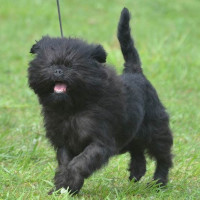
| The Affenchon is a hybrid between the Bichon Frise and the Affenpinscher. Your dog will develop characteristics of both breeds. The Bichon Frise is a small dog with a curly, white coat and dark eyes and nose. Their height varies from 23 to 28 centimeters, and a healthy dog of this breed weighs between 3 and 5.5 kilos. The Affenpinscher, another small dog, averages 25 to 30 centimeters in height and, as an adult, weighs no more than 4 to 6 kilos. Its coat is described as shaggier and rougher. Although the exact appearance of the Affenchon is difficult to determine, as we can never be certain which parent breed a puppy will most closely resemble, we do know that its appearance will fall somewhere in between, with the possibility of a curly, harsh coat. Affenchons are typically feisty with a bright-eyed expression. |
Temperament of the Affenchon |
| These unique hybrid dogs are always happy, but can be hyperactive. Like all dogs joining your family, the Affenchon needs basic obedience training. Commands like sit, stay and come will help you keep your dog under control, even when excited. These dogs are known to be very noisy and like to bark, so a silent command may also prove useful. The Affenpinscher is known to be wary of strangers and is a breed that will certainly need a lot of socialization as a puppy. It will also do well with pets, but not so much with young children. He can be stubborn and will take advantage of what he can get. That's why he needs kind but firm owners who can be confident leaders. The Bichon Frise is a friendly dog who loves spending time with his family, but he is known to be shy and can develop separation anxiety, and will need lots of socialization. These dogs bark a lot and can be difficult to house-train. However, with patience and perseverance, both breeds can be trained to become obedient and respectful pets. As the Affenchon is a combination of the Affenpinscher and the Bichon Frise, its temperament will be similar to that of these breeds. |
Needs and activities of the Affenchon |
| The Affenpinscher and Bichon Frise are hyperactive toy breeds. Without proper training, they can become almost unbearable to live with. As part of their training, you should allow at least 45 minutes a day of physical exercise and at least 30 minutes a day of mental exercise. You can combine physical and mental exercise by hiding toys or using interactive toys that make him think and move. If he doesn't get enough exercise, your dog can easily become a nuisance to your family and neighbors. If you go to dog parks for exercise, make sure he knows good manners and the rules of sociability so he doesn't get into trouble with a bigger dog. |
Maintenance of the Affenchon |
| All dogs, whatever their breed, will need dental care. In general, small breeds like the Affenchon are more prone to gum disease. Get into the habit of brushing your dog's teeth every day, or at least once or twice a week. Nails should also be trimmed as often as necessary, i.e. once or twice a month, or less frequently if they wear down naturally. Although this breed is considered hypoallergenic and sheds very little, it still needs to be brushed regularly. If your Affenchon's coat is similar to that of the Affenpinscher, it may need clipping or trimming a few times a year. The curly coat of the Bichon Frise also needs frequent trimming, and an Affenchon with more curls will benefit from daily grooming. Be patient, gently separating matted areas of fur with your fingers before trying the comb and brush. Your Affenchon will cooperate better if the grooming session is a pleasant experience. Some owners prefer to have a groomer shampoo and trim their Affenchon every four to six weeks or so, which can include trimming, nail care and ear cleaning. |



 English (United Kingdom)

Comments