
 |
Bichon Yorkie |
|
He is not recognized by the F.C.I. |
Origin |
France / Belgium <> Great Britain -> U.S.A. | |
Translation |
Francis Vandersteen |
A brief presentation of the Bichon Yorkie |
| The Yorkie is a hybrid breed created by crossing a Bichon Frise and a Yorkshire Terrier. Bred in the United States, this dog has become a beloved family companion. It's a toy-sized burst of energy that's curious, independent and absolutely loyal. With moderate grooming needs and a trainable intelligence, this alert dog is suited to many environments. The Yorkie is known for its high-pitched bark, which it can use to protect your family and home. Good socialization and early training can reduce misbehavior and ensure that he gets along well with people and pets. |
History of the Bichon Yorkie |
| The Yorkie's true beginnings are not well documented, but we do know that it is a cross between the Bichon Frise and the Yorkshire Terrier. This hybrid breed, created in the USA, is not recognized by the AKC. The Yorkie is recognized by other organizations, such as the American Canine Hybrid Club (ACHC) and the Designer Breed Registry (DBR). |
A little of the Bichon frise |
||
| The Bichon Frise is descended from a Mediterranean breed called the Barbet. It was a medium-sized water dog with a woolly coat, also known as a Barbichon. At some point, the dogs were taken to one of the Canary Islands, Tenerife, probably by Spanish or Portuguese traders. In the 14th century, French, Italian and Spanish sailors brought them to Europe. Other sources claim that the Bichon Frise was developed in Italy and brought to France by soldiers in the 1500s. In both cases, they were popular in the royal courts of France, England and Spain, and were considered favorites by such famous rulers as King Francis I of France and King Henry III of England. In the late 1800s, the Bichon Frise fell out of favor and began to be used by circus performers and to help lead the blind. After the First World War, French breeders worked to preserve the breed and adopted an official standard in 1933. At that time, the breed was called the Tenerife Bichon. In 1956, the Bichon Frise arrived in the United States, where it was recognized by the AKC in 1971. | ||
 |
||
| Standard of the Bichon frise | ||
A little of the Yorkshire Terrier |
||
| In stark contrast, the Yorkshire Terrier was a working-class dog. Scottish workers in the 19th century brought a dog, then called a Paisley Terrier or Clydesdale Terrier, with them when they came looking for work in Yorkshire, England. The dog was crossed with other Terriers to create a much smaller dog that was used to catch rats in the mills where their owners worked. In 1870, the new breed was named Yorkshire Terrier for the place where it was developed. The first registration of a Yorkshire Terrier in the United States dates back to 1872. Yorkshire Terriers were recognized by the AKC in 1885. | ||
 |
||
| Standard of the Yorkshire Terrier |
Appearance of the Bichon Yorkie |
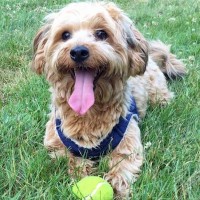
| The Yorkie is a toy-sized breed, like the Bichon Frise and Yorkshire Terrier from which it is descended. The Yorkie's compact, well-proportioned body features a round head with round, dark eyes. The ears can resemble either parent breed, and can stand or hang. A blunt muzzle ends in a black nose, and the tail is long. The coat shows the most similarities with the parent breeds, and may have either set of characteristics. A Yorkie might have long, silky hair like the Yorkshire Terrier, or the dense, soft, curly hair of the Bichon à poil frisé, which resembles a fluffy snowball. Colors can also vary between dogs, and can be combined in white, cream, gold, gray, blue, brown or black. |
Temperament of the Bichon Yorkie |
| The Yorkie has a strong prey drive and can challenge larger animals. It can get along with other pets as long as it receives good socialization. This dog can be a good watchdog, but has a high-pitched voice that can become uncontrollable if proper training is not implemented. They are highly intelligent dogs that are easy to train, and obedience classes can help curb any negative behavior. The Yorkie is a very energetic dog, but exercise requirements for this breed are low. |
Needs and activities of the Bichon Yorkie |
| The Yorkie shares many of the characteristics of its parent breeds, especially its highly inquisitive and energetic nature. They are independent dogs who always want to spend a lot of time with their owners. Although you may find the Yorkie's curiosity will lead him to explore everything, he always wants to be close to his favorite person at all times. He's playful and intelligent, and gets on well with children. However, little ones need to learn how to handle this little dog and should be supervised when in contact with him, as he can easily be injured. |
Maintenance of the Bichon Yorkie |
| Although a hypoallergenic breed, the Yorkie can shed a lot and benefit from brushing up to three times a week. The occasional trip to the groomer can provide a trim or stripe to his coat, and trim the hair around his face and eyes too. The Yorkie isn't known for smelling, but an occasional bath when needed will keep her looking and smelling great. Pay particular attention to her nails, which will need regular trimming, as well as her ears and teeth. Keep her ears clean and hair-free to prevent ear infections, and provide regular dental care to stop gum infections. |



 English (United Kingdom)

Comments