
 |
Coton-Beagle |
|
He is not recognized by the F.C.I. |
Origin |
Madagascar <> Great Britain -> U.S.A. | |
Translation |
Francis Vandersteen |
A brief presentation of the Coton-Beagle |
| The Coton-Beagle is still hard to find, as the Coton de Tuléar is not a very popular breed and is rather new itself. However, with the Coton de Tulear's soft, cottony coat and gentle disposition and the Beagle's sporty, fun-loving personality, the Coton-Beagle has become an excellent pet. These cheerful, intelligent dogs are small, usually measuring around 30.5 centimeters and 9 kilos, with a soft, fluffy coat, floppy ears and a curious expression. They are relatively easy to train and enjoy playing with children and other pets. However, it's best not to leave them alone with young children. |
History of the Coton-Beagle |
| The Coton-Beagle is too recent to have a history, so the stories of the parent breeds are used for this purpose. |
A little of the Coton de Tuléar |
||
| The Coton de Tuléar originated in Madagascar in the 1600s and is thought to have been brought over by French soldiers. The breed is thought to be related to the Italian Bolognese and the French Bichon. The history of the Coton de Tuléar is unclear, as it is a rare breed with few records. However, it is thought that the Coton de Tuléar began life as a companion dog that was popular with wealthy families in a town called Tuléar in Madagascar. The breed was just recognized by the AKC in 2014 and is the 80th most popular breed in America. | ||
 |
||
| Standard of the Coton de Tuléar | ||
A little of the Beagle |
||
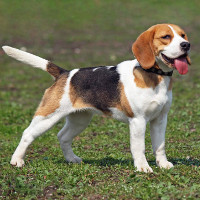
| The Beagle originated in England in the 1300s, where it was used to hunt rabbits and other game. Some believe the name Beagle comes from a French word meaning open throat, in reference to the way the Beagle barks. Others say the name comes from the old English word for small. The first record of the actual name was found in 1475 in writings found from that period onwards. Part of the story says they came from pack dogs used in Roman times, while others claim they were bred by mixing a Harrier with an English dog. Whatever the case, these dogs are excellent hunting dogs and have been used to track rabbits and other animals for hunters. By the 19th century, the Beagle was available in several different sizes, and the pocket Beagle became the most popular because hunters could keep these little 23-centimeter dogs in their pockets. In 1642, the Beagle was first spotted in the United States, but the American version didn't look much like the English version of the Beagle. They looked more like a Dachshund or Basset hound than a Beagle. After the war, English Beagles were imported and bred with American Beagles to produce the modern Beagle we have today. Today, the Beagle is the 5th most popular breed in the USA and was registered with the American Kennel Club (AKC) in 1885. | ||
 |
||
| Standard of the Beagle |
Appearance of the Coton-Beagle |
| The Coton-Beagle can be any color: white, brown, beige, cream, black, red or any combination of these. The coat is soft, fluffy and can be short or medium. The undercoat is semi-permeable and the outer coat dries quickly, so your Coton-Beagle won't worry about getting wet. They generally weigh between 7 and 14 kilos and can measure between 25.5 and 38 centimeters. They are small in stature, with proportionate legs, a long tail and floppy ears. Most resemble furred Beagles, depending on color. They generally have dark eyes and black noses, with large, fluffy feet. |
Temperament of the Coton-Beagle |
| Your Coton-Beagle is a good-tempered dog who is able to make friends with almost anyone, so they don't make good guard dogs. They love people and other animals and will find something fun to do with those around them. However, they like to hang around a lot, so your Coton-Beagle may be on the lazy side. They can get lazy when they're bored, so if you're having trouble stopping your dog from hanging around, give him something to do. Human attention is important to your Coton-Beagle and you mustn't leave him alone for too long or he could become restless or depressed. |
Needs and activities of the Coton-Beagle |
| The Coton-Beagle can be a lazy dog if you let him, but you need to make sure he gets at least 30 to 45 minutes of activity every day. For example, you can take your dog for a 15-20 minute walk twice a day, or take her for a walk in the park and a hike in the woods. She may enjoy agility sports or simply run around the yard or park chasing squirrels and rabbits. You can also take her to a local dog park to play with other dogs, as the Coton-Beagle loves all other animals. |
Maintenance of the Coton-Beagle |
| With the Coton de Tulear's cottony fur, your Coton-Beagle will need frequent, thorough brushing. You may also need to bathe him every few weeks with a mild shampoo specially formulated for dogs. You should brush your Coton-Beagle with a stiff bristle brush and metal comb at least two or three times a week to avoid snags and excessive shedding. To avoid dental problems, brush your dog's teeth with a toothpaste specially designed for dogs. Clean his ears once a week and check for mites, wax build-up and other debris. We also recommend trimming his nails if necessary. |



 English (United Kingdom)

Comments