
 |
Coton Mi-Ki |
|
He is not recognized by the F.C.I. |
Origin |
Madagascar <> U.S.A. -> U.S.A. | |
Translation |
Francis Vandersteen |
A brief presentation of the Coton Mi-Ki |
| A Coton Mi-Ki is a hybrid breed and a cross between a Coton de Tuléar and a Mi-Ki, which was only developed in the 1980s and is therefore also fairly new. The Coton Mi-Ki is a small dog weighing up to 7.5 kilos. It will adopt the characteristics and appearance of both parent breeds, so colors are likely to be white, brown, black, beige and may be tricolor. A Mi-Ki dog has a long or medium, silky coat, while the Coton de Tuléar has a cotton-like coat. Both parent breeds are affectionate and easy to train. The Mi-Ki generally doesn't need as much maintenance as the Coton de Tuléar. |
A little of the Coton de Tuléar |
||
| The history of Coton de Tuléar, a member of the Bichon family, is also poorly documented. They are thought to be descended from dogs that survived a shipwreck off the coast of Madagascar. The Merina, Madagascar's ruling tribal monarchy, kept them as royal court pets in the 17th century. It wasn't until the 1970s that they were brought to France and North America, where they became very popular. They are also known as the "Chien royal de Madagascar". The breed was recognized by the AKC in 2014. | ||
 |
||
| Standard of the Coton de Tuléar | ||
A little of the Mi-Ki |
||
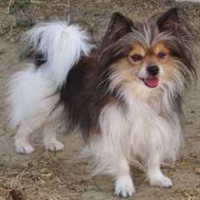
| Apart from being developed in the USA in the late 1980s, not much is known about the origins of these rather rare dogs, but they are thought to share common ancestry with several Asian breeds, including the Japanese Spaniel, Maltese and Continental Toy Spaniel. One unconfirmed theory is that the Mi-Ki was created by breeder Micki Mackin, who used small Shih Tzu as well as Japanese Chin, Maltese and Papillon and possibly Yorkshire Terriers. Because she didn't keep accurate records, the exact combination of breeds used is unclear. However, the Mi-Ki International Registry has carried out DNA profiling via the United Kennel Club to develop and refine the breed. The Mi-Ki International Registry claims to be the breed's founder in development and hopes to make it a purebred American breed. The breed is not yet recognized by the American Kennel Club, although several clubs, including the Mi-Ki Club of America, do, and all have established their own breed standards. | ||
 |
||
| Presentation of the Mi-Ki |
Appearance of the Coton Mi-Ki |
| The Coton Mi-Ki is a mix of a Coton de Tulear and a Mi-Ki, and will take on the appearance and characteristics of both parent breeds. They are small dogs weighing up to 7.5 kilos and are generally white, black and beige, although they can be tricolored. Their coats are normally long or medium-length and generally quite silky. A Coton de Tuléar has a cotton-like coat and is usually white. They have black noses and eyes, which are normally round, dark and wide. Their ears are triangular and set high on the head. Mi-Ki dogs can have smooth or long coats, and may have feathers on their ears. Their eyes are similar in shape and color to Coton de Tuléar, and their noses are also generally black. Their ears can be erect or floppy. Their feet resemble hares and are fairly elongated, whereas the feet of a Coton de Tuléar are small and arched over the back. The Coton de Tuléar is known for its prominent black nose and large, expressive eyes. Their tails curl over their backs. |
Temperament of the Coton Mi-Ki |
| The Coton Mi-Ki is likely to be playful, affectionate and intelligent, like both parent breeds, and will make an excellent pet. A Coton de Tuléar doesn't like to be left alone for long, and can become destructive to show its displeasure. Although they are generally calm dogs, except in the evening, they love to bark and growl when excited. Both are good with children and other pets, and are social dogs who like to be the center of attention. The Mi-Ki is very adaptable to most living conditions, while the Coton de Tuléar will need more exercise and loves nothing more than swimming, running and playing. They are very curious dogs and love to explore. The Mi-Ki is good with strangers and very good-natured, but with all dogs, early socialization and training is a good idea. Both parent breeds are easy to train as they love to please, as well as being good pets for new owners, and a Coton Mi-Ki is likely to be the same. |
Needs and activities of the Coton Mi-Ki |
| A Coton Mi-Ki, like the two parent breeds, won't need much exercise, but will enjoy a daily walk and play sessions. The Coton de Tuléar probably needs more exercise, and loves to swim and play with other dogs. So it all depends on which parent breed is more dominant in your dog. Both parent breeds will enjoy playing games such as chasing balls in a fenced yard, but they are very good dogs for people who live in apartments as long as they are taken out daily to make sure they don't get bored and develop behavioral problems. Coton de Tuléar and Mi-Ki can adapt to most climates, but it's never a good idea to exercise your pet in very hot weather. |
Maintenance of the Coton Mi-Ki |
| A Coton Mi-Ki is probably hypoallergenic, as are both parent breeds, making them good for allergy sufferers. Neither of the parent breeds sheds much, but the Coton de Tulear will need daily brushing and a weekly bath. Their coats easily mat otherwise and may need trimming. Mi-Ki show dogs have shaved heads, necks and ears, as well as feet and legs. Try to brush your dog's teeth every day to avoid any dental problems, and check the ears for dirt. If necessary, wipe them gently with damp absorbent cotton. Nails should also be checked to see if they need trimming, as tears and breaks can occur if nails are left too long. |



 English (United Kingdom)

Comments