
 |
Crested Cavalier |
|
He is not recognized by the F.C.I. |
Origin |
China <> Great Britain -> U.S.A. | |
Translation |
Francis Vandersteen | |
This breed is also known as |
Crested King Charles |
A brief presentation of the Crested Cavalier |
| The Crested Cavalier is an adorable cross between a Chinese Crested Dog and a Cavalier King Charles Spaniel. These active, extroverted companion dogs love to play and snuggle with their owners. As such, they require both constant daily exercise and lots of human affection. Crested Cavaliers have an average lifespan of 11 to 15 years, weigh 4 to 7 kilos and stand 28 to 33 centimeters tall. They have a slender, graceful build and a long, silky coat that comes in many color variations and requires regular brushing. This breed is not yet stable, so it can vary considerably in appearance and temperament. |
History of the Crested Cavalier |
| The Crested Cavalier is descended from two very different parent breeds: the Chinese Crested Dog and the Cavalier King Charles Spaniel, which originated in different worlds. Given the long history of the parent breeds, the Cavalier King Charles Spaniel and Chinese Crested Dog may have been bred in Europe and the USA for over a century. Nevertheless, their hybrid, the Crested Cavalier, is not recognized by the AKC. |
A little of the Chinese Crested Dog |
||
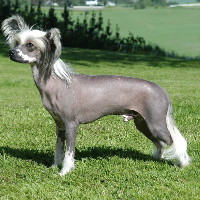
| The Chinese Crested Dog has somewhat mysterious origins, with most cynologists believing that the breed descended from Mexican Naked Dogs, now known as Xoloitzcuintle, or African Naked Dogs, now known as Abyssinian Sand Terriers, and was picked up by shipping merchants in South America or Africa as pets. In the 13th century, the Chinese Crested Dog appeared in port cities around the world. It was particularly prized in China for its ability to hunt small vermin, which earned it the prefix of its name. Nevertheless, the Chinese Crested Dog later spread throughout Europe and North America. In the 1950s, American celebrity Gypsy Rose Lee led an effort to popularize the breed in the USA. Although the American Kennel Club registered the breed in 1991, it never achieved the widespread popularity enjoyed by many toy breeds in the country today. | ||
 |
||
| Standard of the Chinese Crested Dog | ||
A little of the Cavalier King Charles Spaniel |
||
| The Cavalier King Charles Spaniel is a popular breed in Europe and the USA. It is a product of Spaniels and Asian toy hybrids that were bred over several centuries from the 1500s onwards. In the 17th century, Cavalier King Charles Spaniels were one of the most popular breeds in England and got their modern name from their biggest fan at the time, King Charles II. There were no strict breeding guidelines in place for Cavalier King Charles Spaniels, and the purebred variety waned during the 18th and 19th centuries. In the 1920s, however, American financier Roswell Eldridge visited England to purchase two Spaniels. Eldridge offered generous prizes to breeders for the best "ancient" male and female dogs, similar to those depicted alongside King Charles II in works of art and literary accounts. In so doing, Eldridge restored stability to the breed, and the Cavalier King Charles Spaniel was officially recognized by the AKC in 1996. | ||
 |
||
| Standard of the Cavalier King Charles Spaniel |
Appearance of the Crested Cavalier |
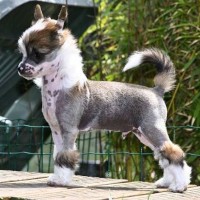
| The Crested Cavalier has a slender, well-balanced build. It has a graceful gait made possible by its long legs and hare feet. This breed has a relatively flat forehead with high ears, almond-shaped eyes and a dark, pointed nose. Crested Cavaliers are considered a toy breed, with an average weight of 4 to 7 kilos and a height of 28 to 33 centimeters. Their coat is medium-length, wavy and silky, with feathering on ears, chest, legs and tail. Dogs resembling the Chinese Crested Dog may have very short or hairless areas around the torso and belly. The coat can be multicolored combinations of apricot, black, white, beige, blue, chocolate, cream, palomino, slate, with white or beige patches or markings. |
Temperament of the Crested Cavalier |
| The Crested Cavalier is an active, graceful and friendly pet. Although fearless like its Spaniel relative, it is also gentle and affectionate towards adults, children and other animals. Human companionship for this breed is a must, and it thrives in a home where it is surrounded most of the time by people willing to play and snuggle at any moment. They are also sensitive dogs that do best in structured, stable environments. Crested Cavaliers are relatively easy to train, and their small size makes them practical for urban or apartment living. However, note that this breed still needs a considerable amount of exercise for its small size. Crested Cavaliers don't have strong hunting or wandering tendencies, so you can count on your Crested Cavalier to stay by your side at all times. In fact, these dogs can be happiest when simply relaxing indoors with their owners. |
Needs and activities of the Crested Cavalier |
| The Crested Cavalier is an active breed that needs daily exercise and lots of attention to stay happy and healthy. Crested Cavaliers love daily walks and outings to the dog park, as well as appropriate play sessions with their owners. Despite their energetic personalities, Crested Cavaliers are just as happy vegging out on the sofa with their owners. As such, it's important to incorporate an equal balance of play and rest into your Crested Cavalier's program. Note that this breed is well adapted to all types of climates, however, owners should ensure that their pet is not exposed to significant amounts of sun if it has hairy areas on its body. |
Maintenance of the Crested Cavalier |
| Crested Cavaliers are not completely hypoallergenic, but produce fewer allergens due to their hair-like coat on their Chinese Crested Dog side. These are minimal droppings, but it may be necessary to brush them regularly if they have a longer coat. When grooming, owners should trim the dog's ears, face and feet to avoid infections or impediments to mobility. Some owners opt for professional grooming if their dog's coat is particularly long. Crested Cavaliers should also be bathed once a month and, like all dog breeds, have their teeth brushed daily and their nails trimmed once or twice a month. Although rare, owners should take every precaution to protect their dog's hairless areas, as the skin can be sensitive. |



 English (United Kingdom)

Comments