
 |
Crested Cocker |
|
He is not recognized by the F.C.I. |
Origin |
China <> Great Britain -> U.S.A. | |
Translation |
Francis Vandersteen | |
This breed is also known as |
Chinese Cocker |
A brief presentation of the Crested Cocker |
| This lively, affectionate hybrid dog is a hearty mix between the purebred English Cocker Spaniel and the Chinese Crested Dog. Although Crested Cockers are not stabilized in appearance, they generally resemble slender Cockers with some Chinese Crested Dog facial features. Beyond that, they generally weigh between 7 and 11.5 kilos, reach a height of 30.5 to 38 centimeters and live up to 15 years. Crested Cockers' coats are available in many color variations, some are bare in the areas around their torso and legs due to the hairless Crested Chinese Dog ancestry. This breed does not require strenuous exercise, but remains an energetic dog that thrives on human attention and companionship. Unlike their parent breeds, Crested Cockers are a relatively new combination and, as such, are not recognized by the American Kennel Association. |
History of the Crested Cocker |
| The English Cocker Spaniel and the Chinese Crested Dog have been bred together in Europe and the USA since the early 20th century to create the hybrid commonly known as the Crested Cocker or Chinese Cocker. The English Cocker Spaniel and the Chinese Created have very different histories. |
A little of the Chinese Crested Dog |
||
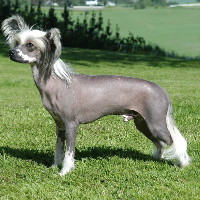
| The Chinese Crested Dog is an ancient breed believed to be descended from the Xoloitzcuintle or Abyssinian Sand Terrier, two hairless dogs from Africa and Mexico respectively. Early versions of the Chinese Crested Dog lived all over the world on ships and in port cities from the 13th century onwards, where they were kept as pets by merchants to hunt small vermin on ships and docks. This breed became particularly popular in Chinese cities, hence the prefix of the Chinese name to crested. It wasn't until the 1800s that people began to keep the Chinese Crested Dog as a pet, mainly in Europe and the USA. In fact, in the 1920s, famous stage personality Gypsy Rose Lee spearheaded a movement to popularize the breed in North America. She was quite successful, and the Chinese Crested Dog was officially recognized by the American Kennel Club in 1991. Nevertheless, the breed is not very popular among toy dog owners today. | ||
 |
||
| Standard of the Chinese Crested Dog | ||
A little of the English Cocker Spaniel |
||
| The English Cocker Spaniel comes from England and was bred in the 1800s for sporting purposes, particularly woodcock hunting. The close relationship between England and America led to the breed's migration to North America, where it became a popular show dog, pet and hunting companion. Until the mid-1900s, English and American Cockers were considered the same. However, divergent breeding practices in the two countries led to a smaller variety (the "American" Cocker Spaniel) and a larger variety (the "English" Cocker Spaniel). They are now considered two distinct breeds by the American Kennel Club, the American version having been recognized in 1878 and the English version in 1945. | ||
 |
||
| Standard of the English Cocker Spaniel |
Appearance of the Crested Cocker |
| A Crested Cocker generally resembles a slender Cocker Spaniel with a few crested Chinese features, including a delicate muzzle and ears. It's a small breed whose constitution lies somewhere between the compact body of the English Cocker Spaniel and the fine-boned Chinese Crested silhouette. They have long tails, dark noses and eyes, and small, compact feet. Crested Cockers have an average weight of 7 and 11.5 kilos, and reach heights of 30.5 to 38 centimeters. The length and color of their coats can vary considerably, with some having full coats with longer hair around the face, feet and ears, while others have shorter coats or hairless areas around the torso and legs. The heavily coated areas consist of stiff, soft "hair" and can be multicolored combinations of apricot, black, beige, blue, chocolate, cream, palomino, slate, white, brown, buff, red and silver with merle, spotted or roan markings. |
Temperament of the Crested Cocker |
| Crested Cockers are sensitive dogs known for being affectionate, playful and alert pets. This breed becomes very attached to its owners and loves to be loved. Crested Cockers also get on well with children and enjoy lively indoor play sessions with family members. However, they can be shy around strangers and may take some time to familiarize themselves with new people and animals. Note that because this breed is so people-oriented, they will become restless and anxious if left alone for long periods. In addition, Crested Cockers are very aware of their surroundings and are occasional barkers, but don't tend to be yappy or overly hyperactive. Yet they are intelligent dogs and respond very well to obedience training. In fact, these dogs may be happiest when they relax indoors and follow their owners' instructions. This trait makes Crested Cockers well suited to urban or apartment living. |
Needs and activities of the Crested Cocker |
| The Crested Cocker is a fun, playful breed that requires a little daily exercise and a lot of human affection. Crested Cockers will appreciate a moderate daily session of walking and playing. This breed is good for city or apartment living, as it doesn't require a large amount of exercise. Crested Cockers are also well suited to all types of climate. However, owners should ensure that their pet is not exposed to significant amounts of sun or cold if it has hairless areas on its body. Also note that this breed has a strong impulse to hunt, so Crested Cockers can chase smaller animals and should always be supervised when in off-leash areas. On the whole, Crested Cockers are mainly indoor dogs who spend a lot of time snuggling up to family members. |
Maintenance of the Crested Cocker |
| Crested Cockers are not completely hypoallergenic, but produce fewer allergens due to their hair-like coat on their Chinese crested side. They are moderate shedders, but should be brushed regularly if they have a longer coat. When grooming, owners should trim the ears, face and feet to avoid infections or impediments to the dog's mobility. Crested Cockers should also be bathed once a month and, like all dog breeds, have their teeth brushed daily and their nails trimmed once or twice a month. Owners should take every precaution to protect their dog's hairless areas with clothing or skin treatments to avoid topical irritation or infection. |



 English (United Kingdom)

Comments