
 |
Crested Havanese |
|
He is not recognized by the F.C.I. |
Origin |
China <> Western Mediterranean -> U.S.A. | |
Translation |
Francis Vandersteen | |
This breed is also known as |
Chinese Havanese |
A brief presentation of the Crested Havanese |
| The Crested Havanese, a cross between the Chinese Crested Dog and the Bichon Havanais, is a playful, robust hybrid dog. At maturity, they weigh between 2.5 and 6 kilos and grow to around 25.5 to 30.5 centimeters in height. Crested Havenese have a relatively long life expectancy of 12 to 15 years. Personality-wise, these puppies are people-oriented and known for their eager-to-please attitude. They can be quite energetic and require a fair amount of exercise for their size. Crested Havanese also have a silky coat that requires occasional brushing and comes in many color variations common to both parent breeds. Nevertheless, they are generally an easy breed to train and maintain. Although its parents are breeds registered with the American Kennel Club, the Crested Havanese is not completely stabilized in temperament or appearance and has not yet been recognized by the organization. |
History of the Crested Havanese |
| The name Crested Havanese comes from its two parent breeds: the Chinese Crested Dog and the Havanese Bichon, also known as the Havana Silk Dog. The origin of the breeding of the Chinese Crested Dog and the Havanese together is unknown, but it is likely to have occurred in North America in the second half of the 20th century to create the Crested Havanese. |
A little of the Chinese Crested Dog |
||
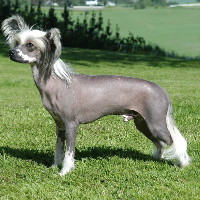
| The Chinese Crested Dog has a somewhat debated history. Many believe it originated in Africa from an ancient hairless breed and migrated to Asia on merchant ships in the 1200s. Another theory is that it comes from another hairless dog that originated in Mexico and was kept as a pet by the Aztec population, perhaps the same dog from which the Chihuahua originated. Whatever the case, the Chinese Crested Dog eventually became widespread in port cities around the world due to its tendency to be taken up by global traders, particularly in China where it got the prefix to its name. In the middle of the 20th century, there was a movement in the United States to popularize the dog breed by a number of public figures and celebrities. This effort helped establish the breed in North America and led the American Kennel Club to register the Chinese Crested Dog in 1991, although it is not very popular in the USA today. | ||
 |
||
| Standard of the Chinese Crested Dog | ||
A little of the Havanese Bichon |
||
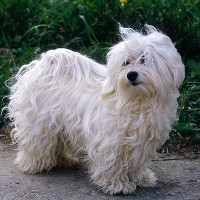
| The Crested Havanese's other relative, the Bichon Havanais, is Cuba's national dog. It originated in the Mediterranean region and was imported to Cuba by Spanish traders in the early 16th century. The breed eventually became a symbol of wealth in Cuba and was bred exclusively for the country's elite families. Many Havanese Bichon were trained as interpreters because of their intelligence and attention-seeking personality. This increased their popularity not only in Cuba, but also in Europe in the mid-18th century. During the Cuban revolution, the class of Cubans who owned Havanese Bichon were the first to leave the country, bringing a handful of dogs to the USA, where the breed was recognized by the AKC in 1996. | ||
 |
||
| Standard of the Havanese Bichon |
Appearance of the Crested Havanese |
| A Crested Havanese generally resembles a slender Havanese with a few Chinese Crested features, including a wedge-shaped face, high fluffy ears and round, dark eyes. It's a small breed with a build somewhere between the compact torso of the Havanese and the slim silhouette of the Chinese Crested Dog. Crested Havanese tend to average between 2.5 and 6 kilos in weight, and grow to 25.5 to 30.5 centimeters in height. Their long, straight, soft coat, which is relatively shorter around the torso and legs, can be multicolored combinations of apricot, black, beige, blue, chocolate, cream, palomino, slate, white, brown, buff, red, and/or silver with merle, spotted or roan markings. Crested Havanese also have medium-length, feathered, well-coated tails and small, compact paws. |
Temperament of the Crested Havanese |
| Well-adapted, Crested Havanese are known to be affectionate, playful and people-oriented pets. Their size and moderate exercise requirements make them excellent pets for dog owners living in houses, apartments or smaller urban environments. Beyond that, they are sensitive dogs who require daily structure and constant attention to stay happy and healthy. As a result, Crested Havanese love to follow their owners around and receive demonstrations of affection. What's more, Crested Havanese are not known for being yappy or hyper, despite the toy breed's reputation. These traits make Crested Havanese excellent traveling companions. However, it also means they are prone to separation anxiety. Owners who are away from home for long periods may not be a good match for this hybrid. Crested Havanese also get on well with children and enjoy lively indoor play sessions with family members. As far as other dogs are concerned, however, this breed can be suspect on first encounter. As such, introductions to furry friends should be made slowly and under supervision. |
Needs and activities of the Crested Havanese |
| Moderate daily exercise and attention will satisfy a Crested Havanese. These dogs enjoy a moderate daily walk or play session at the dog park, depending on temperament. This breed will also require mental stimulation and will entertain itself by learning and performing tricks for family members. Owners living in very sunny or very cold climates should ensure that their Crested Havanese is not exposed to harsh sunlight or long periods of cold if it has hairless areas on its body. What's more, Crested Havanese have a strong urge to hunt, so they need to be closely supervised in off-leash areas. |
Maintenance of the Crested Havanese |
| Crested Havanese are hypoallergenic and an excellent pet option for allergy sufferers. They should be bathed and have their nails trimmed monthly. This hybrid doesn't shed, but should be brushed regularly and carefully with a pin or smooth brush to avoid matting. Coat trimming is also an option for Crested Havanese with particularly long coats. If a Crested Havanese resembles its hairless Chinese Crested parent, owners should protect bare areas with clothing or treatments to avoid skin irritation. Some owners opt for professional grooming because of the breed's sometimes unpredictable coat. In addition, Crested Havanese should have their teeth brushed daily to avoid dental disease. |



 English (United Kingdom)

Comments