
 |
Doxie-Chin |
|
He is not recognized by the F.C.I. |
Origin |
Germany <> Japan -> U.S.A. | |
Translation |
Francis Vandersteen |
A brief presentation of the Doxie-Chin |
| The Doxie-Chin is a hybrid of a Dachshund and a Japanese Spaniel. Because two registered pure breeds were intentionally crossed, the Doxie-Chin is considered a creation breed. The Doxie-Chin is a small dog weighing from 4.5 to 11.5 kilos. Their coat can be fine or wiry, and should be brushed 2-3 times a week. The Doxie-Chin will have the physical and personality traits of both its parents. It will be a gentle, happy and sensitive dog. Because of their small size, the Doxie-Chin may not be a good breed for families with young children. Small children can sometimes be a bit rough, which can injure the dog and lead to biting. The Doxie-Chin is generally not a barker and can adapt quite well to apartment life if need be. |
History of the Doxie-Chin |
| The Doxie-Chin is a modern breed. Consequently, documentation on their history is limited. We can take a closer look at the history of its parents. |
A little of the Dachshund |
||
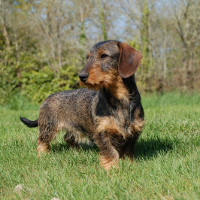
| Dachshunds are thought to have originated in Germany in the early 1600s. They were used as hunting dogs to drive game from their dens. They were even used to hunting wild boar in packs of dogs. The Dachshund was bred to be strong, courageous and alert. The word Dachshund literally means "badger hunting dog" in German. The original Dachshund was larger than today's Dachshund, weighing from 13.5 to 18 kilos, and had longer legs. The American Dachshund Club was founded in 1881. The first Dachshund registered with the American Kennel Club dates back to 1885. During the First and Second World Wars, the Dachshund lost popularity due to its association with Germany. Today, the Dachshund ranks 13th on the AKC's list of most popular dogs. Dachshunds excel in field trials and earth dog trials. In the USA, Terrier trials are organized by the American Kennel Club and the American Working Terrier Association. | ||
 |
||
| Standard of the Dachshund | ||
A little of the Japanese Spaniel |
||
| The Japanese Spaniel is thought to have originated in China. Exactly how they arrived in Japan is debated. There are various notions, such as that they were brought to Japan by Buddhist teachers, or that they were gifted to a Japanese empress by a Chinese ruler. Japanese Spaniels were kept as companion dogs by the Japanese imperial family. They were forbidden to belong to the people. The first Japanese Spaniels were brought to America in 1853 by Commodore Matthew Perry. The dogs were kept as pets. The American Kennel Club officially recognized the breed in 1888, under the name "Japanese Spaniel". The AKC officially changed the breed's name to Japanese Chin in 1977. Japanese Spaniels have been beloved companions of Blondie, the Osbourne family, Joan Rivers and Shah Rukh Khan. | ||
 |
||
| Standard of the Japanese Spaniel |
Appearance of the Doxie-Chin |
| The Doxie-Chin will have the physical characteristics of both its parents. It will be a small dog weighing from 13.5 to 18 kilos. Its coat can be fine or wiry, and can be a combination of colors such as black, tan, white, brown, gray, merle or gold. The Doxie-Chin's ears are generally long and floppy. Its body will be longer than the Japanese Spaniel. Its muzzle is shorter than that of the Dachshund. The Doxie-Chin's eyes and nose are dark. |
Temperament of the Doxie-Chin |
| The Doxie-Chin's temperament is a combination of the personalities and characters of the Dachshund and Japanese Spaniel. Japanese Spaniels are compared to cats because they love to climb and perch on furniture or higher staircases. They are devoted, sensitive, loving and affectionate. Dachshunds are very alert and make good watchdogs. Dachshunds need early socialization with strangers and other dogs. Dachshunds and Japanese Spaniels don't like to be left alone and can suffer from separation anxiety. Separation anxiety can lead to behavioral problems such as barking, chewing and scratching at the door. A professional dog behaviorist may be able to make some suggestions to help him overcome his fears. Your hybrid will be a devoted companion who needs lots of love and attention to keep him happy and secure. |
Needs and activities of the Doxie-Chin |
| The Dachshund has a moderate energy level and the Japanese Spaniel has a low energy level. Your Doxie-Chin will have a low to moderate level of energy expenditure. He will enjoy daily walks and interactive play. Your Doxie-Chin may also enjoy visiting a dog park and exploring a fenced-in yard. However, he should not be left unsupervised in a yard, as he can easily dig his way out. The Doxie-Chin is sensitive to high temperatures. During the summer months, it should be walked in shady streets. Interactive play in hot weather can include tossing his favorite toy down a long corridor or working his nose. These activities will also satisfy his cognitive needs. The Doxie-Chin does best in a family that's willing to take the time to stimulate his mind as well as work his body. |
Maintenance of the Doxie-Chin |
| The Doxie-Chin should be brushed several times a week to remove dead and loose hairs. They only need to be bathed every three to four months. Only dog shampoo should be used, as human shampoo can dry out a dog's skin. Teeth should be brushed weekly to prevent tartar build-up and gum disease. Nails should be trimmed monthly if they don't wear naturally. Crate training is useful when your puppy is a demolisher. Puppies may chew things they shouldn't. It's important to provide chew toys so they don't chew on dangerous objects or consume something that may be harmful. |



 English (United Kingdom)

Comments