
 |
Doxie Scot |
|
He is not recognized by the F.C.I. |
Origin |
Germany <> Great Britain -> U.S.A. | |
Translation |
Francis Vandersteen |
A brief presentation of the Doxie Scot |
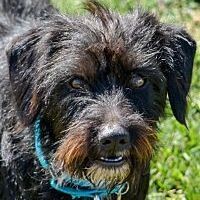
| The Doxie Scot is a hybrid between a Dachshund and a Scottish Terrier. As a specific crossbreed, not much is known about the Doxie Scot, and this hybrid may inherit its appearance and other traits from either parent. The Doxie Scot is an outgoing, active dog that is very agile given its stature and long body. They are also fearless and loyal to their families, but require early socialization to other dogs and pets. Both parents are excellent alarm barkers, so expect the Doxie Scot to bark too. Both the Scottish Terrier and the Dachshund tend to bond with only one family member, so socialization is essential for a happy, healthy Doxie Scot. |
History of the Doxie Scot |
| The Doxie Scot is a hybrid of the Dachshund and the Scottish Terrier. The hybrid is a modern breed with no history outside its parent breeds. Personality and physical characteristics may reflect either parent breed, and little is known about the hybrid. Currently, the Doxie Scot is recognized by the American Canine Hybrid Club, the Designer Breed Registry, the Designer Dogs Kennel Club, the Dog Registry of America and the International Designer Canine Registry as a Doxie Scot. To better understand potential Doxie Scot traits, owners should examine the histories and characteristics of the parent breeds. |
A little of the Dachshund |
||
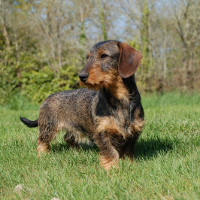
| The Dachshund originated in Germany, where its name means badger dog, a nickname based on the Dachshund's favorite quarry, the badger. The Dachshund was bred to lie down to dig and hunt prey on the ground, such as badgers, hares and foxes. The breed dates back to at least 15th century Germany, and may share ancestors with the French Basset Hound and certain Terrier dogs to produce today's elongated earth dog. The Dachshund breed standard was drafted in 1879, and the dog made its first appearance in the USA in 1888, where 11 dogs were first registered with the American Kennel Club. Today, the Dachshund is the only dog recognized by the AKC to be both an above-ground and an underground hunter. | ||
 |
||
| Standard of the Dachshund | ||
A little of the Scottish Terrier |
||
| The Scottish Terrier's long-extinct ancestor, the Scotch Terrier, was first described in 55 BC. The Romans named this determined dog Terrarii, meaning "workers of the earth". For several centuries, the Terrier group lived in Scotland and England, also moving into Germany and France. By the 1800s, the Scottish Terrier was firmly established as a small wire-haired Terrier of the Skye group, which differed from the smooth-haired Terriers of England. | ||
 |
||
| Standard of the Scottish Terrier |
Appearance of the Doxie Scot |
| The Doxie Scot is a small to medium-sized hybrid between the Dachshund and the Scottish Terrier. Your Doxie Scot may resemble the Scottish Terrier with a stiff, usually black coat, but can also adopt the sleek Dachshund look with black and tan, brown, red or white coats. Ears are slightly larger than Scottish Terriers, and set lower on the head. Scottish Terriers are low to the ground but proportionate to their size, while the Dachshund's stature is exaggerated. The Doxie Scot retains the exaggerated look, with sturdy legs and a longer body than the Scottish Terrier. A Doxie Scot's tail is carried at back level and can curl slightly, but it can also stand up when the dog is excited, just like its Scottish Terrier parent. |
Temperament of the Doxie Scot |
| The Doxie Scot has a very energetic temperament like its Scottish Terrier parent, and is often serious. It can be vocal and opinionated when upset, and is an excellent alarm barker. The Doxie Scot tends to bond with a single family member and is best suited to families with older children who already know how to handle a dog. The Doxie Scot needs human companionship but doesn't like to be teased or engage in rough play, regardless of its agile nature. A little wary of strangers and sometimes shy, the Doxie Scot will gauge new people and quickly form an opinion. Showing respect and remaining cheerful is the best way to approach a Doxie Scot, as the Scottish Terrier is sensitive to human emotions. This hybrid is intelligent but can sometimes be slightly stubborn. The Dachshund parent means that the Doxie Scot can respond well to food-based reward training, but Scottish Terriers are better known for their independence and your Doxie Scot can do as he pleases. |
Needs and activities of the Doxie Scot |
| With all the energy and agility inherited from the Scottish Terrier, the Doxie Scot is still very low to the ground and doesn't need high-intensity activity. However, the Doxie Scot does require daily exercise. A brisk 30-minute walk twice a day is enough to satisfy the Doxie Scot, but be slightly more attentive on walks. The sturdy legs of a Dachshund may not move as fast as the quick steps of a Scottish Terrier. The Doxie Scot is a moderately active hybrid that is a little calmer than the Scottish Terrier parent thanks to the calm Dachshund. However, your Doxie Scot can still be an active dog. As far as climates are concerned, the Dachshund parent doesn't tolerate cold at all, but the Doxie Scot achieves a good balance and can be well adapted to temperate climates. Both parents adapt well to apartment living, so you can expect a Doxie Scot to do well in town or country if properly exercised. Proper exercise will also keep the Doxie Scot's mind sufficiently stimulated and may prevent any digging or rooting into the earth, traits common to both parents. |
Maintenance of the Doxie Scot |
| If a Doxie Scot's coat resembles its hypoallergenic parent, the Scottish Terrier, this hybrid will lean towards low shedding and most likely cause few problems for allergy sufferers. A smooth, softer coat generally indicates a resemblance to a Dachshund and will increase potential allergies. However, the Dachshund is not known for shedding much. Regular brushing will maintain the look and feel of this hybrid, and a variety of brushes should be used every week. Stiff brushes, hound gloves and wide-tooth combs are ideal grooming accessories you can use to keep the coat healthy. Bathing is not suggested for this hybrid unless necessary, as the Scottish Terrier parent's skin is sensitive. The Doxie Scot is the parent of two breeds that are also not known for having a doggy smell. Regular ear cleaning is recommended for the Doxie Scot, given this hybrid's slightly longer and more flexible ears. |



 English (United Kingdom)

Comments