 |
Elk-Kee |
|
He is not recognized by the F.C.I. |
Origin |
Norway <> Germany -> U.S.A. | |
Translation |
Francis Vandersteen |
A brief presentation of the Elk-Kee |
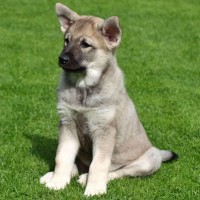
| The Elk-Kee is a hybrid dog that is a cross between a gray Norwegian Elkhound and a German Spitz / Keeshond. They are medium-sized dogs weighing up to around 20.5 kilos. Common colors are likely to be black, silver, gray or cream, while their coats are likely to be short, thick and smooth. The Elk-Kee is likely to make a good pet that gets on well with children and will be fairly easy to train. The German Spitz / Keeshond is more reactive to training, but both parent breeds are suitable for new pet owners, so the Elk-Kee is also likely to be. The Elk-Kee will need regular exercise. Both parent breeds shed a lot and need to be brushed quite often. |
History of the Elk-Kee |
| An Elk-Kee is a hybrid breed composed of a cross between a German Spitz/Keeshond and a Norwegian Grey Elkhound. |
A little of the Norwegian elkhound grey |
||
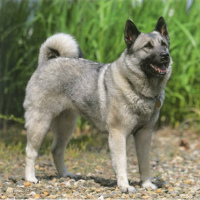
| The Norwegian Gray Elkhound is Norway's national dog and one of the oldest dog breeds, dating back around a thousand years to Viking times. One of the ancient Northern Spitz-type dogs, the Norwegian Gray Elkhound was bred as a hunting and guard dog often used to track animals such as moose, elk, bear, cougar and rabbit. They kept prey at bay by barking until the hunter arrived. They are also popular as sled dogs. The Norwegian name is Norsk Elghund, meaning Norwegian Moose Dog. The breed was recognized by the American Kennel Club in 1913. | ||
 |
||
| Standard of the Norwegian elkhound grey | ||
A little of the German Wolfsspitz / Keeshond |
||
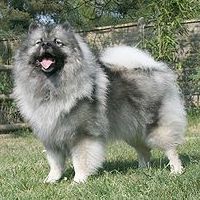
| The German Wolfsspitz / Keeshond is also a member of the Spitz, or Nordic, dog family, and is also called a Dutch Barge Dog. The breed was named after Cornelis (Kees) de Gyselaer, who was a Dutch patriot and leader of the rebellion against the House of Orange. When the House of Orange returned to power, the breed fell into disfavor and virtually disappeared. They were rediscovered in 1905 by a Miss Hamilton-Fletcher, later Mrs. Wingfield-Digby, and later taken to England. In 1920, Baroness van Hardenbroek travelled to Holland to generate more interest in the breed and formed the Nederlandse Keeshond Club in 1924. The first American litter of German Spitz / Keeshond was bred in 1929 by Carl Hinderer and the breed was registered with the American Kennel Club in 1930. | ||
 |
||
| Standard of the German Wolfsspitz / Keeshond |
Appearance of the Elk-Kee |
| Elk-Kee dogs are medium-sized dogs that are a cross between a German Spitz / Keeshond and a gray Norwegian Elkhound. Common colors are likely to be black, silver, gray or cream, while their coat is likely to be short, thick and smooth. The Gray Norwegian Elkhound has dark brown, oval-shaped eyes and ears set high on the head, while the German Spitz / Keeshond is known for its unique facial markings that appear to form spectacles, with a dark line running from the outer corner of each eye towards the ear. Their eyes are dark brown, almond-shaped with black rims, while their ears are small, dark, triangular and erect. Both parent breeds have tails that curl over the back, so the Elk-Kee is also likely to do so. |
Temperament of the Elk-Kee |
| Elk-Kees are likely to make excellent pets and are very good with children, like both parent breeds. They will be intelligent dogs, but will need solid training to ensure they recognize you as the leader of the pack. German Spitz / Keeshond are independent and make good watchdogs but love to be part of the family and its activities, a bit like the Norwegian Grey Elkhound who doesn't like to be left out. They are very loyal and can be quite possessive of their family. German Spitz / Keeshond will probably be a little easier to train than a Grey Norwegian Elkhound, so it will depend on which parent breed the Elk-Kee takes most to know how easy it will be to train, but as with all breeds, patience and positive reinforcement are the best paths to take. Both parent breeds will need to be stimulated physically and mentally, as they are energetic dogs. The Gray Norwegian Elkhound is friendly to strangers but can be aggressive towards other dogs. Early socialization is therefore important, while the German Spitz / Keeshond is somewhat wary of strangers but gets along with other dogs. |
Needs and activities of the Elk-Kee |
| The Elk-Kee is likely to need regular exercise to keep fit, happy as both parent breeds are energetic dogs. Gray Norwegian Elkhounds particularly like fairly intense activity. They can exercise for about an hour a day while walking or playing, but will also love to run. They should be kept on a leash as they tend to wander and may take off after an interesting scent. A German Spitz / Keeshond also needs daily exercise and will enjoy a walk or a run. They also enjoy water, so a trip to the beach will be an option. They have been known to run in circles when feeling energetic, usually a sign that it's time to play or go for a walk. Both parent breeds tend to tolerate cold more than heat. The ideal home would be one with an enclosed yard, but Elk-Kees would do well in an apartment provided they get daily exercise. |
Maintenance of the Elk-Kee |
| An Elk-Kee will need regular grooming to keep it looking good, which will include brushing about three times a week. Both parent breeds shed quite frequently, so the Elk-Kee is also likely to do so. The coats of both parent breeds tend to be naturally clean and they have no doggy odor, so you don't need to bathe him often. Neither parent breed is hypoallergenic, so an Elk-Kee is unlikely to be either. Try to brush your dog's teeth two or three times a week to avoid dental problems. Check the ears regularly and wipe them with a damp absorbent cotton pad. Check the nails regularly and trim them if they are too long. |



 English (United Kingdom)

Comments