
 |
Eng-A-Poo |
|
He is not recognized by the F.C.I. |
Origin |
Great Britain <> France -> U.S.A. | |
Translation |
Francis Vandersteen | |
This breed is also known as |
English Toy Spoodle |
A brief presentation of the Eng-A-Poo |
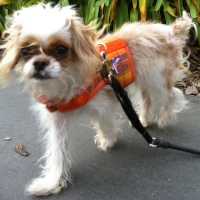
| The Eng-A-Poo is a hybrid breed where the King Charles Spaniel is crossed with the Poodle. This friendly dog tends to be small, averaging less than 6.5 kilos, and is intelligent, playful, loyal and affectionate. An Eng-A-Poo can be shy when meeting new people, but once comfortable, it will make an excellent companion. What's more, the Eng-A-Poo will get on well with other dogs and, thanks to socialization, will get along with other pets in the home as well as with children able to handle the dog appropriately. Owners of this hybrid say it's fun to own and a great addition to any family, but especially an active one. |
History of the Eng-A-Poo |
| The hybrid known as the Eng-A-Poo is a new breed of dog that has no detailed history, although both parent breeds can be studied. |
A little of the King Charles Spaniel |
||
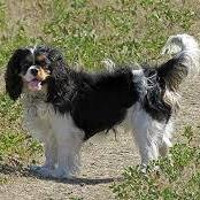
| The King Charles Spaniel is an adorable dog with a sensitive nature. In fact, it was the breed's docile, gentle manner that made it the darling of the royal courts of Brittany. Often called "Charlies", these dogs were adored by King Charles I and his son King Charles II. Mary, Queen of Scots, was another great fan of the breed, as was Grand Duchess Anastasia Nikolaevna. After the death of these kings, the breed was further developed and bred with the Pug and Japanese Spaniel, giving it the small, flat nose characteristic of the breed today. Also known as the Spaniel doudou, this dog has become a great companion. | ||
 |
||
| Standard of the King Charles Spaniel | ||
A little of the Poodle |
||
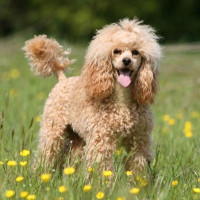
| Officially, the Poodle is recognized as originating in France, and its earliest ancestors are thought to have been curly-coated dogs from Asia. Truly a German dog by descent, the Poodle's development into what we know today took place in France. Initially, the Poodle was a water dog, known for its duck hunting and retrieving skills. The design of the Poodle's coat trim that we consider fashionable today was in fact carved so that its legs and belly wouldn't get caught on reeds and trees in the water as it retrieved game for the hunter. His incredible intelligence later led him to a time as a circus performer, and more recently the breed has served man well as a guide dog, guard dog, service dog and competition dog. | ||
 |
||
| Standard of the Poodle |
Appearance of the Eng-A-Poo |
| The Eng-A-Poo is a small dog, generally weighing less than 6.5 kilos as an adult, with a short body and relatively long legs. Brown or white in color, the Eng-A-Poo's coat will vary according to the traits it inherits from its parent breeds, and may be straight, curly or wavy. Facial features may be more indicative of one breed or another, with the Poodle having a long muzzle and the Spaniel a shorter, flatter nose with wide nostrils. Its head may be domed, as with the influence of the Spaniel, or more refined and pointed like the Poodle, and its ears will be long and rather feathery. His eyes are always dark and bright, with an air of courage and intelligence, and his gait is open and cheerful. |
Temperament of the Eng-A-Poo |
| The Eng-A-Poo will inherit its temperament from its parent breeds. It is known to be shy with new people at first, then very affectionate and loyal to family members. As a general rule, the Eng-A-Poo will be intelligent, although the ease with which he trains will depend on whether he is attached to his generally eager-to-please Poodle parent or his independent and sometimes difficult-to-train King Charles Spaniel parent. An Eng-A-Poo will like to be surrounded by his family and will do well with other dogs. Socialization will help the Eng-A-Poo get along with other pets and children. Young children who are very noisy and don't treat the Eng-A-Poo gently can overwhelm it. |
Needs and activities of the Eng-A-Poo |
| While the Poodle is generally very energetic, the King Charles Spaniel is less active and needs less exercise. It's likely that your Eng-A-Poo will require moderate activity. He should be given toys to play with to keep him occupied indoors, and will enjoy a walk once or twice a day. An Eng-A-Poo will enjoy spending time at the dog park as well as running and playing in a fenced yard. He may enjoy obedience or agility, as the Poodle parent is known to excel in these sports. Because of its small size, the Eng-A-Poo will live well in an apartment. |
Maintenance of the Eng-A-Poo |
| The care of your Eng-A-Poo will depend on the coat it inherits. It will probably be important to groom your Eng-A-Poo regularly to keep its coat knot-free and clean. Brushing his coat several times a week with a good-quality pincushion brush and giving him a bath as needed should suffice. The fur around his eyes and in his ears should be trimmed. His coat can also be clipped by a groomer if necessary. He may experience tear stains on his fur, so gently wipe the area around his eyes. His teeth should be brushed at least every other day to prevent tartar build-up. His long ears should be checked for moisture and dirt, especially if he's a fan of water. |



 English (United Kingdom)

Comments