
 |
English Boston-Bulldog |
|
He is not recognized by the F.C.I. |
Origin |
U.S.A. <> Great Britain -> U.S.A. | |
Translation |
Francis Vandersteen |
A brief presentation of the English Boston-Bulldog |
| The English Boston-Bulldog dog breed is a friendly, small to medium-sized dog with a strong, sturdy body. A combination of traits from the parents of the Boston Terrier and the English Bulldog results in a hybrid dog breed devoted to the family and a committed family member. They can be sensitive and don't like to be ignored or left alone for too long. This hybrid dog breed likes to relax with the owner and family, although they will happily join in a game of fetch. They can suffer from exposure to extreme heat, which can cause heat stroke, and they dislike intense cold. The English Boston-Bulldog is lively as a puppy, but slows down with age. |
History of the English Boston-Bulldog |
| The English Boston-Bulldog is a hybrid breed of dog, the result of crossing the Boston Terrier with the English Bulldog. Although historical data is scarce for the new breed of dog, we can study the history of the parents to determine the characteristics that make up the English Boston-Bulldog. Today, the English Boston-Bulldog benefits from the constitution and courage of the parent dog's history, but has become a gentle, lovable dog. |
A little of the Boston Terrier |
||
| The Boston Terrier is the result of selective breeding of Bull and Terrier types and has produced a small-sized dog. These tough little dogs were once fighting dogs and originated in Boston, Massachusetts. They are one of the few breeds developed in America. In 1865, coachmen employed by the wealthy began to crossbreed the breed. The offspring crossed with the French Bulldog, providing the basis for the Boston Terrier. The new dog was named after its birthplace and officially recognized by the American Kennel Club in 1893. A terrier in name only, the Boston Terrier was bred to be gentler in nature than the arena-fighting dogs of the past. | ||
 |
||
| Standard of the Boston Terrier | ||
A little of the English Bulldog |
||
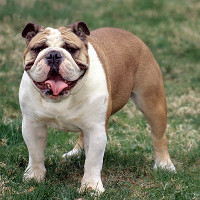
| The English Bulldog has its origins in the British Isles and is a descendant of the Asian Mastiff. He had a bloody past, being used in bull sport, where he attacked adult bulls in the fighting arena. These dogs were aggressive, ferocious and very brave. With strong determination and a total lack of fear, they would attack the bull from below. They got their name "bull" from this insipid sport. Fortunately, today's Bulldog has a very different, gentle temperament from its ancestors, but it still retains some of the strong will and therefore needs a strong leader. | ||
 |
||
| Standard of the English Bulldog |
Appearance of the English Boston-Bulldog |
| The English Boston-Bulldog is a solid, compact dog with a well-muscled body, with a deep chest that is proportionate to the size of the body. Their legs are straight and sturdy, with rounded paws. Their heads are often more Bulldog-like, being large and still solid. They have a short muzzle, a broad black nose with wide nostrils, and large cheeks. Their upper lip is quite large and folds over a lower jaw. The eyes are deep-set and round, fairly dark in color, and the ears are often thin and folded back. They have short tails that are carried low on the body. This beautiful hybrid has a glossy, short-haired coat. |
Temperament of the English Boston-Bulldog |
| This happy hybrid breed is an adorable, almost comical dog, known for its calm temperament and love of children. They are energetic puppies, but mellow as they get older. They're very affectionate, easy to care for and don't need much space to live in. Ideal for apartments, small houses and city or country living, these gentle dogs will integrate perfectly into family life. Responding well to training, they listen to commands and obey orders. When you train your English Boston-Bulldog, it learns quickly, so expect fewer repetitions when training this dog. Be firm but gentle in your instructions, as some English Boston-Bulldogs can be sensitive by nature. They respond best to lots of praise and rewards, and are eager for attention and affection. Socialize your dog from his first puppy days with outings that bring him into contact with other dogs and people. They'll have fun on the dog beach or at the dog park. This is where they can learn valuable skills for coexisting peacefully with other dogs. |
Needs and activities of the English Boston-Bulldog |
| When young, your English Boston-Bulldog will be lively and full of energy, requiring daily exercise and plenty of playtime. But as he gets older, you'll find that he'll probably prefer to lounge by your side. Even if they're happy with inactivity, it's in your dog's best interest to walk him every day to keep him fit and flexible. This dog is sensitive to the climate, so be aware that excessive heat can cause heat stroke in your dog, so make sure he has a cool place to relax during summer heatwaves. They are ideal for apartment living, as they are inactive indoors. |
Maintenance of the English Boston-Bulldog |
| With an attractive, easy-care coat, the English Boston-Bulldog requires minimal brushing and bathing only when necessary. Use a dog shampoo for sensitive skin, as they are prone to skin irritation. If your dog has folds around the face or body, make sure they are dry and free of debris that can cause skin problems. The ears and eyes of this busy hybrid need constant checking to make sure they remain healthy and to eliminate any infections that may arise. Gently wipe around these areas with a soft, damp cloth and dry any folds of skin. Train your English Boston-Bulldog when he's young to get used to having his teeth cleaned and brushed. This practice is easier to teach at a young age than at maturity. But in time, your English Boston-Bulldog will love the attention and adapt well to routine grooming. |



 English (United Kingdom)

Comments