 |
Giant Kerry Blue Schnauzer |
|
He is not recognized by the F.C.I. |
Origin |
Ireland <> Germany -> U.S.A. | |
Translation |
Francis Vandersteen |
A brief presentation of the Giant Kerry Blue Schnauzer |
| The Giant Kerry Blue Schnauzer is a cross between a Kerry Blue Terrier and a Giant Schnauzer. The common colors of the parent breeds are black, salt and pepper, silver, blue, slate blue and gray. A Giant Schnauzer has a stiff, hard, dense coat that's easier to maintain, while that of the Kerry Blue Terrier is soft, dense and wavy. Neither of the parent breeds sheds much, so it's unlikely that the Giant Kerry Blue Schnauzer will either. The Giant Kerry Blue Schnauzer is likely to be playful and energetic like the parent breeds. It is likely to be a good dog for a family, but could also be used as a working dog in the police or army. |
History of the Giant Kerry Blue Schnauzer |
| The Giant Kerry Blue Schnauzer is a specific cross between a Giant Schnauzer and a Kerry Blue Terrier. |
A little of the Kerry Blue Terrier |
||
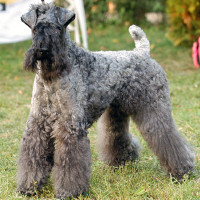
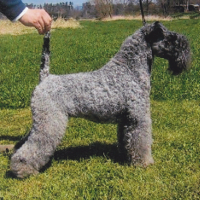
| Also known as Irish Blue Terriers, Kerry Blue Terriers come from County Kerry, Ireland, where they have been purebred for over a hundred years. They were working dogs and were bred as farm dogs to hunt small game and kill rats. They were also used to guard sheep and cattle. They became known as "Blue Devils" at early dog shows when they had to catch rabbits and bring in a barking badger, and are still quite aggressive with other dogs today. The breed was officially recognized by the American Kennel Club in 1924. Irish nationalist leader Michael Collins owned a Kerry Blue named Convict and in the early 1900s, shortly before his death, he introduced legislation to name the breed the national dog of Ireland. | ||
 |
||
| Standard of the Kerry Blue Terrier | ||
A little of the Giant Schnauzer |
||
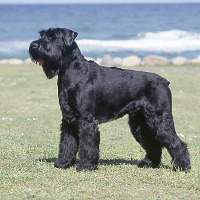
| The Giant Schnauzer was developed in Germany as one of three distinct Schnauzer breeds, Miniature, Standard and Giant. It is thought that the Giant Schnauzer was created by crossing the Standard Schnauzer with the Black Great Dane and possibly the Bouvier des Flandres. They were bred as farm dogs and later used as guard dogs, often in breweries. In Germany, they were used by the police and as military dogs during both World Wars, and are still used today as working dogs. Giant Schnauzers first arrived in America in the 1930s and were registered by the American Kennel Club in 1930. The Giant Schnauzer Club of America was founded in 1962. | ||
 |
||
| Standard of the Giant Schnauzer |
Appearance of the Giant Kerry Blue Schnauzer |
| The Giant Kerry Blue Schnauzer is a cross between a Kerry Blue Terrier and a Giant Schnauzer. Common colors of the parent breeds include black, salt and pepper, silver, blue, slate blue and gray. A Giant Schnauzer has a stiff, hard, dense coat, while Kerry Blue is soft, wavy and dense. Giant Schnauzers have broad, muscular bodies with distinct beards and eyebrows. They have oval-shaped eyes that are dark brown and sunken, and tails that are generally docked. Kerry Blue Terriers are also muscular and robust, with long heads, flat skulls and deep chests. They have small black eyes and their tails are normally docked. Your hybrid will have a dense coat that can vary from hard to soft. It will have dark eyes that may be framed by eyebrows. The Giant Kerry Blue Schnauzer will have an agile gait and a purpose to it when walking. |
Temperament of the Giant Kerry Blue Schnauzer |
| A Giant Kerry Blue Schnauzer is likely to adopt many traits from their parent breeds and is therefore likely to be an excellent pet that may be best in a home with older children. The Giant Schnauzer is very protective of its family and wary of strangers, but is a playful and energetic dog. They are highly intelligent dogs, but will need early socialization as they can be aggressive with other dogs and cats. When it comes to training, the Giant Schnauzer needs a firm, confident master. The Kerry Blue is also energetic and a breed that needs plenty of exercise, early socialization and constant training. They don't get on well with other dogs, but are good with children. They don't like to spend much time alone, otherwise they can get bored and are likely to dig or bark. They are good watchdogs and can also protect their family and not trust strangers. Your hybrid may do best in a home where he's number one and the only one, however, he can adapt to animal housemates if introduced to them when he's young. |
Needs and activities of the Giant Kerry Blue Schnauzer |
| The Giant Kerry Blue Schnauzer will need plenty of exercise to stay fit and happy. A Giant Schnauzer needs at least an hour of intense exercise every day, and can become very destructive if it doesn't get enough. Kerry Blue Terriers also need plenty of exercise, otherwise they can become bored, digging and barking. Both parent breeds can be aggressive with other dogs, so it's best to keep your Giant Kerry Blue Schnauzer on a leash when out in public. They will also chase other animals if given the opportunity, so they need to be supervised. But both parent breeds love to play, so the Giant Kerry Blue Schnauzer is also likely to do so. This hybrid prefers it when it's cooler, so don't walk them in the heat of the day, and they'd prefer a house with a yard, rather than trying to adapt to apartment life. |
Maintenance of the Giant Kerry Blue Schnauzer |
| The Giant Kerry Blue Schnauzer probably needs moderate maintenance, but doesn't shed that much. Both parent breeds are hypoallergenic, making them suitable for allergy sufferers. The Giant Schnauzer needs trimming around the eyebrows, beard and on the body, while the Kerry Blue also needs trimming, which is best left to a professional groomer. Your hybrid will need daily brushing to avoid matting, but will be odorless and need baths only when absolutely necessary. Try to brush your dog's teeth every day to avoid any dental problems, and check his ears for dirt. If necessary, wipe them gently with damp absorbent cotton. Nails should also be checked to see if they need trimming. |



 English (United Kingdom)

Comments