 |
Giant Ratzer |
|
He is not recognized by the F.C.I. |
Origin |
U.S.A. <> Germany -> U.S.A. | |
Translation |
Francis Vandersteen |
A brief presentation of the Giant Ratzer |
| The Giant Ratzer is a cross between a Rat Terrier and a Giant Schnauzer, one a small breed and the other a large one, so your pet may vary depending on which parent breed is more dominant. Common parent breed colors are black, salt and pepper, white, beige, chocolate, blue, gray, lemon and apricot. Rat Terriers can be bicolored or tricolored, so a Giant Ratzer could be too, and their coats are smooth compared to the Giant Schnauzer, which has a stiff, hard, dense coat. Your pet will probably need moderate maintenance and won't shed too much. A Giant Schnauzer is energetic and intelligent and needs regular exercise, just like the Rat Terrier. While the Giant Schnauzer isn't confident around children, the Rat Terrier is quite at ease. Supervision around youngsters will be necessary even once you know what personality your Giant Ratzer displays. |
History of the Giant Ratzer |
| The Giant Ratzer is a specific cross between a Giant Schnauzer and a Rat Terrier. |
A little of the Rat Terrier |
||
| Unsurprisingly, the Rat Terrier was bred to catch rats and other small vermin, mainly on farms. It's an American breed and was developed from Fox Terriers, Old English White Terriers, Manchester Terriers, Bull Terriers and then crossed with Beagles, Whippets and Italian Greyhounds, among others. Some believe that President Theodore Roosevelt named the breed when his dog solved the rat problem at the White House. The Teddy Roosevelt Terrier is also known as the Short-legged Rat Terrier. Today, the Rat Terrier is not only a pet, but also a working dog used as a service dog in hospices and as a police dog. In 1972, the first hairless Rat Terrier was born. The hairless Rat Terrier is known as the American Hairless Terrier and is either miniature or standard. There is also a larger variety, called the Decker or Decker Giant, named after breeder Milton Decker. The Rat Terrier was officially recognized by the American Kennel Club in 2013. | ||
 |
||
| Presentation of the Rat Terrier | ||
A little of the Giant Schnauzer |
||
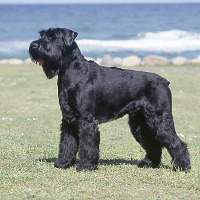
| The Giant Schnauzer was developed in Germany as one of three distinct Schnauzer breeds, Miniature, Standard and Giant. The Giant Schnauzer is thought to have been created by crossing the Standard Schnauzer with the Black Great Dane and possibly the Bouvier des Flandres. Often found working in breweries as guard dogs, they were also bred as farm dogs. In Germany, they were used by the police and as military dogs during both World Wars, and are still used as working dogs today. Giant Schnauzers first arrived in America in the 1930s and were registered by the American Kennel Club in 1930. The Giant Schnauzer Club of America was founded in 1962. | ||
 |
||
| Standard of the Giant Schnauzer |
Appearance of the Giant Ratzer |
| The Giant Ratzer is a cross between a Rat Terrier and a Giant Schnauzer. Common parent breed colors include black, salt and pepper, white, beige, chocolate, blue, gray, lemon and apricot. The Giant Ratzer can be bicolor or tricolor with a smooth coat, or it can inherit a stiff, hard, dense coat, all depending on which parental genes are predominant. Giant Ratzers generally have a broad, muscular body and may have the distinct beard and eyebrows of their parent. They have oval-shaped eyes that are either hazel or dark brown and deep-set. Ears are usually pricked, and in countries where the practice is permitted, the tail is usually docked. |
Temperament of the Giant Ratzer |
| A Giant Ratzer is likely to adopt many traits from their parent breeds and should therefore make an excellent pet, although it may be best in a home with older children. The Giant Schnauzer is very protective of its family and wary of strangers, but is a playful and energetic dog. They are highly intelligent dogs, but will need early socialization as they can be aggressive with other dogs and cats. When it comes to training, the Giant Schnauzer needs a firm, confident master. Rat Terriers are friendly, energetic dogs that are easy to train, but like most Terriers, they will need to be socialized early. Rat Terriers can be stubborn and love to dig, so plenty of mental and physical stimulation is needed to prevent the formation of bad habits. The Giant Ratzer can be a little wary of strangers, but is good with children it knows as long as respect is taught to both parties. This hybrid loves their owners and tends to pick up on their moods. |
Needs and activities of the Giant Ratzer |
| The Giant Ratzer will need plenty of exercise to stay fit and happy. A Giant Schnauzer needs at least an hour of intense exercise every day, and can become very destructive if they don't get enough. They love to run or go for long walks, but must be kept on a leash, like Rat Terriers, to avoid chasing other dogs. Rat Terriers are very energetic despite their size and also need plenty of exercise, but can be very stubborn. They love ball games and are happy to go for long walks. Depending on the size of your pet, it can adapt to life in an apartment, provided you take it out for regular exercise. Rat Terriers don't like the cold, while Giant Schnauzers prefer it when it's cooler. You'll need to pay close attention to how the climate affects your Giant Ratzer: depending on its coat and temperament, the amount of time it spends outdoors will need to be adapted to the weather. |
Maintenance of the Giant Ratzer |
| The Giant Ratzer will probably need moderate maintenance like the two parent breeds. The Giant Schnauzer is hypoallergenic, but the Rat Terrier is not, so the amount of excretion will depend on who your pet takes after more. The Giant Schnauzer should be trimmed around eyebrows, beard and body, while the Rat Terrier will look great with weekly brushing with a soft brush or rubber glove to remove loose hair. A Giant Ratzer is unlikely to shed much, and will only need a bath if absolutely necessary. Try to brush your dog's teeth every day to avoid any dental problems, and check that the ears aren't dirty or wet. If necessary, wipe them gently with damp absorbent cotton. Nails should also be checked to see if they need trimming. |



 English (United Kingdom)

Comments