
 |
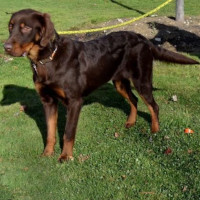
Irish Dobe Setter |
|
He is not recognized by the F.C.I. |
Origin |
Ireland <> Germany -> U.S.A. | |
Translation |
Francis Vandersteen |
A brief presentation of the Irish Dobe Setter |
| The Irish Dobe Setter is an intentional cross between the carefree Irish hunting dog, the Irish Red Setter and the Dobermann, an unsurpassed personal protection dog from Germany. The Irish Dobe Setter should ideally be a slightly more focused and serious dog than the Irish Red Setter, and is less likely to develop overprotectiveness or dominant behavior than Dobermann bloodlines. This dog needs plenty of daily exercise to expend energy and maintain its athletic physique, as well as regular brushing to control its persistent shedding, and is not well suited to apartment living. |
History of the Irish Dobe Setter |
| The Irish Dobe Setter is not a pure-bred dog. It is a specific cross between the Dobermann and the Irish Red Setter. The best way to determine the temperament of a mixed breed is to look for all the breeds in the cross. It's possible that you'll get any combination of any of the characteristics found in either breed. Not all designer hybrid dogs are 50/50 purebred. It is very common for breeders to create multi-generational crosses. Please examine individual breeds for potential health problems. |
A little of the Irish Red Setter |
||
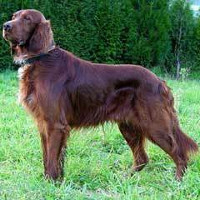
| The Irish Red Setter was developed at some point in the 1700s in Ireland as a field hunting dog, and by the early 1800s the breed was popular not only in Ireland, but also in the British Isles. Unfortunately, records of the dog's early development are non-existent, although most experts believe it to be an ancestor of breeds such as the Irish Water Spaniel, Gordon Setter and Irish Terrier. Early Irish Setters were bred to be able to search for birds, then hold their position so they didn't enter the line of fire, and were often red and white or yellow and white, but by the mid-1800s the dark red color we know today had become the ideal. They were imported to the United States as hunting dogs specializing in game birds in the mid-1800s and were recognized by the American Kennel Club in 1878. | ||
 |
||
| Standard of the Irish Red Setter | ||
A little of the Dobermann |
||
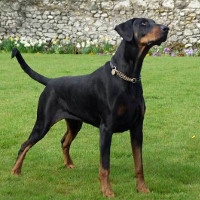
| The Dobermann is also a fairly new breed, originating in Germany at some point in the 1890s. The breed's founder was a man named Karl Friedrich Louis Dobermann, a dog breeder and tax collector by trade. He was looking for the perfect personal protection dog to accompany him on his rounds, someone who was intelligent, loyal and courageous, with a naturally protective instinct and reliable nature. Although Mr. Dobermann kept records of the dogs he used, the records were not particularly clear and some of the dogs he used were of indeterminate breed. Some of the breeds said to have been used to develop the Dobermann include the German Pinscher, Black & Tan Terriers and Hounds, Beauceron dogs and a breed known as the Thueringen. Since their inception, these dogs have provided exemplary service as soldiers, guard dogs and police dogs, often giving their lives for the safety of others. There is, however, a softer side to these dedicated and courageous dogs, and they can be gentle, loving and affectionate companions, loyal and steadfast to those they love. | ||
 |
||
| Standard of the Dobermann |
Appearance of the Irish Dobe Setter |
| The Irish Dobe Setter is a fairly large dog, measuring around 61 centimeters high at the shoulder, with long, straight legs and a fairly square shape, although this hybrid can sometimes be slightly longer than it is tall. Their heads are generally quite long and elegant, with a long muzzle that can be straight and square or slightly tapered with a black or brown nose. They have almond-shaped eyes in various shades of brown, although the placement and shape of the ears can vary somewhat as the Dobermann has ears that are set high on the head and, if not cropped, fold forward and hang level with their jaw whereas the Irish Red Setter's ears are set below eye level and hang close to the head, almost far enough to reach their nose. The coats of the two breeds are also quite different, and the Irish Dobe Setter may inherit one of the traits of the short, hard, single-layer coat of the Dobermann or the coat of the Irish Red Setter, which consists of a soft, dense undercoat covered by a layer of flat, medium-length fur with silky feathers located on the belly, ears, legs and tail. |
Temperament of the Irish Dobe Setter |
| There can be quite a few temperament variations for this particular crossbreed. The Dobermann, in general, is a fairly reserved and dignified breed that can sometimes play the clown, while the Irish Red Setter is a demonstrative and carefree breed that can settle down as a hunting dog if need be. The Irish Dobe Setter is likely to have a temperament somewhere in between, a dog that can be as serious as it is clownish. They are generally friendly towards children, although this dog can be a little too energetic or exuberant for the little ones and Dobermann genetics can sometimes induce overprotectiveness in this dog, although their behavior with other animals can differ from dog to dog and they can get along easily with other animals or chase them away. Whatever the individual personality with which this dog is born, early and thorough socialization is essential for these dogs to avoid or mitigate the negative traits that can occur from time to time, such as shyness, distractibility and perhaps even inappropriate aggression. This dog is a combination of two highly trainable breeds, although harsh training techniques are generally counterproductive for the Irish Red Setter and Dobermann, and the Irish Dobe Setter can become bored if training is too repetitive. |
Needs and activities of the Irish Dobe Setter |
| Both parent breeds need plenty of vigorous exercise every day to stay their happiest and healthiest, as does the Irish Dobe Setter. While a long walk or jog with their owner is always appreciated, this dog has a number of alternative activities it can enjoy that can help expend excess energy, such as rally, agility training and tracking activities. The Irish Dobe Setter is not particularly well suited to apartment living due to its size, activity level and somewhat vocal nature, and will be happiest in a larger home with plenty of land or a fenced yard. |
Maintenance of the Irish Dobe Setter |
| This hybrid doesn't have a strong dog order and should only require bathing a few times throughout the year, however, it does require brushing several times a week. If your dog has a short, hard coat, similar to that of the Dobermann breed, effective brushing can be achieved in a short time with a smoother brush or grooming glove, this will help remove loose or loose hairs and help stimulate the skin underneath, improving the circulation of skin oils. Dogs with the longer, silkier coat of the Red Irish Setter will need a little more time for brushing to ensure there are no tangles or matting, and a metal rake is a more appropriate tool for this type of coat. Longer coats may also need trimming from time to time to keep them healthy and tidy, this can be done by yourself or by a professional groomer. |



 English (United Kingdom)

Comments