
 |
Irish Doodle |
|
He is not recognized by the F.C.I. |
Origin |
Ireland <> France -> U.S.A. | |
Translation |
Francis Vandersteen | |
This breed is also known as |
Irish Doodle Setter
|
A brief presentation of the Irish Doodle |
| The Irish Doodle is an intentional hybrid dog breed. They are a cross between two dog breeds, the Irish Red Setter and the Poodle, bred for their hunting and retrieving skills, who are generally intelligent, sensitive and active animals with a penchant for people. These dogs make pleasant, playful and entertaining family companions who are generally tolerant of children and other animals as long as they receive sufficient mental stimulation and attention. A bored or lonely Irish Doodle can quickly become anxious or destructive. Both parent breeds are still used for hunting today, and the crossbreed should certainly be up to the task of hunting and retrieving, but they can also shine in agility competitions, advanced obedience training, freestyle dancing and tracking. |
History of the Irish Doodle |
| The Irish Doodle is a hybrid dog, a cross between two very different breeds of hunting dog. A German retriever, the Poodle, and an elegant red hound called the Red Irish Setter. Although the Red Irish Setter can be crossed with a miniature or toy Poodle, the Poodle most commonly included for this hybrid is the Standard Poodle. |
A little of the Irish Red Setter |
||
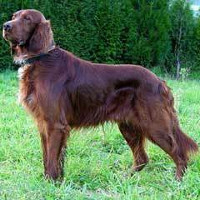
| The Irish Red Setter was developed at some point in the 1700s in Ireland as a field hunting dog, and by the early 1800s the breed was popular not only in Ireland, but also in the British Isles. Unfortunately, records of the dog's early development are non-existent, although most experts believe it to be an ancestor of breeds such as the Irish Water Spaniel, Gordon Setter and Irish Terrier. Early Irish Setters were bred to be able to search for birds, then hold their position so they didn't enter the line of fire, and were often red and white or yellow and white, but by the mid-1800s the dark red color we know today had become the ideal. They were imported to the United States as hunting dogs specializing in game birds in the mid-1800s and were recognized by the American Kennel Club in 1878. | ||
 |
||
| Standard of the Irish Red Setter | ||
A little of the Poodle |
||
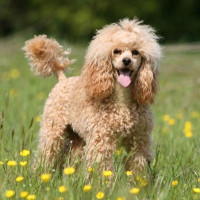
| The Poodle is often associated with France, but it was actually developed in Germany, where it was known as the Pudlehund, Pudle meaning paddling and hund meaning dog. Many people regard the Poodle as a companion or trained entertainment animal, especially the miniature and toy varieties, however, the Poodle was originally bred to be an assiduous Retriever of waterfowl in the same venery as Labradors or Golden retrievers. The Standard Poodle and sometimes even the Miniature Poodle can still fulfill this role quite admirably, although the Miniature Poodle generally concentrates on small game birds. In fact, their haircut was designed to reflect this history, with the leg length and body shaved to reduce drag and avoid tangles in weeds, but vital organs and joints are still covered with a thick layer of protective hair. Today, Poodles are still sometimes used to retrieve waterfowl, although the modern hunter is more likely to cut them short all over to avoid tangling them in brush and weeds. | ||
 |
||
| Standard of the Poodle |
Appearance of the Irish Doodle |
| The Irish Doodle is a medium to large dog with a square build and a fairly narrow, elegant head and long muzzle that can be square and robust like the Red Irish Setter or straight and fine like the Poodle. They have medium to dark brown eyes that can be almond-shaped or oval, and their ears are set slightly below eye level and hang over the sides of their face. The Irish Doodle's coat can vary somewhat from dog to dog, both in composition and color. The Poodle parent has a single-layer coat that is soft and curly and can be long, cut short or even corded, a style that closely resembles dreadlocks and can be available in several solid colors. The Red Irish Setter, on the other hand, has a double coat that consists of a soft, dense undercoat covered with shiny, flat hairs that generally come in several shades of dark red, although large patches of color on white can sometimes appear. As a rule, the coat of offspring puppies is similar to that of the Poodle. |
Temperament of the Irish Doodle |
| The Irish Doodle is an intelligent, energetic but sometimes sensitive animal that craves human companionship. They are extremely intelligent and love to learn, making them an exceptionally trainable dog. In fact, some can resemble the Red Irish Setter, and once they've learned something, you'll find it hard to get them to unlearn. This trait can apply both to things you want them to learn, like obedience and manners, and sometimes to things you don't want them to learn, like how to get into drawers and cupboards. Both the Red Irish Setter and the Poodle are extremely good with children in most cases, although some Poodle lines are more physically sensitive than others, surprising easily and excessively with stimuli such as quick actions, unexpected touches and loud sounds. Irish Doodles with these traits may not handle children well and may become depressed or otherwise emotionally disturbed in a home with lots of conflict or too much chaos, and need to be extensively but calmly socialized to help them learn to deal with external stimuli. In most cases, however, this combination will result in a carefree companion who loves to play and learn. |
Needs and activities of the Irish Doodle |
| The Irish Doodle is an energetic, athletic animal and, as such, requires a fairly substantial time commitment to exercise. In order to be at their healthiest and happiest, this eager-to-learn puppy should get at least 90 minutes of vigorous exercise a day. This can take the form of walks or jogging, advanced obedience training, agility classes or even swimming. Because of their trainability, you may be able to acclimatize a mature Irish Doodle to apartment life if you provide extra exercise every day, but for the most part they are too active and vocal for this type of environment and will be much happier in a larger home with a yard to run around in. |
Maintenance of the Irish Doodle |
| Bathing need not be frequent with these dogs, usually a few times a year, but thorough brushing and styling will usually be required on a regular basis. The type of grooming tools that will be needed for this dog may vary a little, depending on the parent breed it most closely resembles, although most will need to be trimmed or trimmed on a regular basis. Crosses that inherit the single-layer Poodle coat are less likely to shed and, in some cases, may even be weak enough to be considered hypoallergenic, however, the Red Irish Setter coat is decidedly not hypoallergenic, and the full coat composition may not reveal itself until your Irish Doodle has reached maturity. It's also very important to check and clean this dog's ears regularly, as they can be prone to internal and external infections. |



 English (United Kingdom)

Comments