 |
Lhasapoo |
|
He is not recognized by the F.C.I. |
Origin |
Tibet <> France -> U.S.A. | |
Translation |
Francis Vandersteen |
A brief presentation of the Lhasapoo |
| The Lhasapoo is a hybrid dog. Its parents are the Lhassa Apso and the Poodle. They are intelligent, gentle and affectionate dogs. They are relatively small, usually weighing no more than 9 kilos. Ideal for singles looking for companionship, older couples feeling the loneliness of the empty nest and families with children, he'll be happy living in an apartment or house with a fenced-in yard. He's quite active and surprisingly protective of his family. He will need a minimum of daily exercise. The type of coat and amount of maintenance your Lhasapoo will need depends on the coat it inherits from its parents. |
History of the Lhasapoo |
| The Lhasapoo is a specific cross-breed, and has become very popular in recent times. However, there isn't much information on the birth of the hybrid breed. So, to find out more about the Lhasapoo, we need to take a look at the parent breeds. |
A little of the Lhassa Apso |
||
| Buddhist monks living in the Tibetan mountains developed the Lhassa Apso as sentinels for temples and monasteries. Some believe the dogs are descended from Tibetan Terriers, while others think the breed may have been influenced by dogs from the North. After studying the breed's DNA, it seems that one of the Lhassa Apso's ancestors could be a type of mountain wolf. The breed was developed to withstand cold temperatures, and their judgment helped them determine whether someone approaching was friend or foe. Dogs of the breed were never sold, although the Dalai Lamas occasionally gave a pair to imperial families and visiting dignitaries. In 1933, the breed arrived in the United States when the 13th Dalai Lama presented a group of small dogs to Mr. and Mrs. Suydam Cutting. The beginning of the breed in the USA came from these dogs, and the breed was recognized by the American Kennel Club in 1935. | ||
 |
||
| Standard of the Lhassa Apso | ||
A little of the Poodle |
||
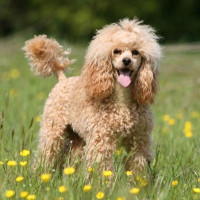
| The Poodle is another breed that has been around for centuries. Experts believe it is a mix of several European Water Dogs and the now extinct North African Barbet. Eventually, the breed we know as the Poodle found its way to Germany, where it was used for its hunting abilities. The exact date of origin of the Poodle is not known, but there are Poodle-like dogs depicted on Egyptian and Roman works of art. The dogs depicted are usually retrieving game or guarding animals. The standard Poodle is traditionally used for duck hunting, and smaller Poodles were used to sniff out truffles in the woods. Eventually, traveling artists learned that the Poodle is an adept show dog. Poodles were not very populous in the United States until after the Second World War. However, for several decades, the Poodle was the most popular breed in the U.S.A. | ||
 |
||
| Standard of the Poodle |
Appearance of the Lhasapoo |
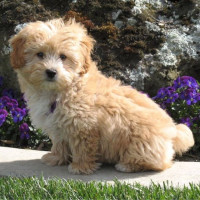
| The Lhasapoo is a cute, cuddly combination of its parent breeds. Although its exact appearance is determined by the dominant parent breed, we can be sure that the Lhasapoo will be small and long-haired. It's likely that its hair will be wavy. Interestingly, the Lhasapoo is hypoallergenic. It can be white, black, brown, beige or a mixture of these colors. Its legs are short but sturdy. He will have a long, slender tail that can curl over his back. His ears are well set and long, but not considered floppy. There may be feathering on its belly, legs and ears. |
Temperament of the Lhasapoo |
| The Lhasapoo is a loving, happy and energetic little dog. He has a tendency to bark, but normally this is because something is out of place, like company. Remember that the Lhassa Apso was a guard dog in Tibet, so it's natural for the Lhassapoo to protect its family and territory. For the Lhasapoo, his human family is the center of his world. It loves children, the elderly and people in general. However, it is advisable to supervise younger children with the Lhasapoo, as some little ones tend to pull the dog's long hair and hurt it. Early socialization is essential to teach your Lhasapoo what behavior is acceptable. Also, the Lhasapoo is prone to separation anxiety, so if you work long hours or are away from home for long periods, the Lhasapoo may not be the right dog for you. |
Needs and activities of the Lhasapoo |
| The Lhasapoo is energetic, but not overly active. Bear in mind that its parent breed, the Poodle, is known to be destructive if bored. Give your Lhasapoo plenty of chew toys and take him for short, brisk walks to eliminate any nervous energy, and avoid destroying your furniture or shoes. He'll also enjoy playing with you indoors. The key is to make sure he gets regular activity, even for short periods throughout the day. He'll also make friends at the dog park and may surprise you by jumping from sofa to sofa. Observers often say that Lhasapoo seems to “fly” when he does. |
Maintenance of the Lhasapoo |
| The Lhasapoo is likely to have very long hair. In fact, one expert says that if you take your dog to be clipped, expect to come home with half the dog you thought you had. Depending on the dominant parent breed, the Lhasapoo may have thick, curly hair, or it may have silky, stiff, very long hair. He should be brushed daily if you decide not to cut his coat. If it is cut, brush it weekly. Trim his nails once every two weeks. As a general rule, if you hear his nails clicking on a tiled floor, it's time to trim his nails. Also, brush his teeth two or three times a week to prevent tartar build-up and bad breath. However, to prevent gum disease, brush daily. |



 English (United Kingdom)

Comments