 |
Pug-a-Mo |
|
He is not recognized by the F.C.I. |
Origin |
China <> U.S.A. -> U.S.A. | |
Translation |
Francis Vandersteen |
A brief presentation of the Pug-a-Mo |
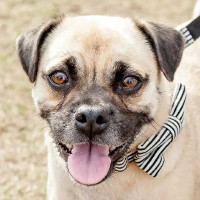
| The Pug-a-Mo is a hybrid dog. Its parent breeds are the Pug and the American Eskimo Dog. It's a small dog, weighing no more than 11.5 kilos at maturity. He's great with children and other pets. He's very affectionate and, surprisingly, a relatively energetic dog. He's loyal and protective of his family. He's intelligent and curious. He is courageous and generally unafraid; if he thinks something needs checking, he has no problem investigating. He learns quickly and is considered easy to train. Bear in mind, however, that he can be territorial. |
History of the Pug-a-Mo |
| The Pug-a-Mo is a hybrid dog. Although there isn't much information on the hybrid breed, we can learn more about the parent breeds to understand the origins of the Pug-a-Mo. |
A little of the Pug |
||
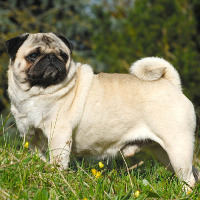
| The Pug originated in the Orient. It is thought to have existed as early as 206 B.C. Some experts believe it is related to the Tibetan Mastiff, but it is certain that Chinese emperors of many dynasties loved the dog and considered it very valuable. When China began trading with European countries, the Pug also became a traded commodity. Just as it had been with Chinese royalty, the Pug also became a favorite of European nobility. Marie Antoinette also owned a Pug. Pugs were first exhibited in 1861 in England, where dog lover and breeder Queen Victoria owned and bred Pugs. The Pug made its way to the United States after the Civil War, and was registered with the American Kennel Club in 1931. | ||
 |
||
| Standard of the Pug |
A little of the American Eskimo Dog |
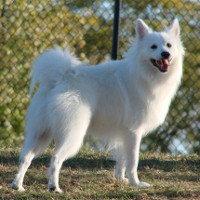
| The American Eskimo Dog is a member of the Spitz family of Nordic origin. The exact origin of the American Eskimo Dog is unknown, however, most believe it is related to small white dogs found in German immigrant communities. The American Spitz spent much of its time as a performer, traveling with circuses and entertaining crowds. In 1917, the American Spitz was renamed the American Eskimo Dog, although there was no distinct reason for the name change. It was first registered by the American Kennel Club in 1995. |
 |
| Presentation of the American Eskimo Dog |
Appearance of the Pug-a-Mo |
| The Pug-A-Mo will be a small dog, with males generally a little larger than females. The male will be closer to 51 centimeters at the shoulder in height, and the female will be closer to 30.5 centimeters at the shoulder. The female is generally closer to 7 kilos and the male is closer to 11.5 kilos. Normally, the Pug-A-Mo is white or cream in color. This depends on the dominant parental breed. It will usually have black markings around the eyes, nose and lips. Sometimes this dark marking can be brown. Often the muzzle is marked like that of a Pug. It will usually have a ruff around the neck. Its tail is curly and may be feathered. |
Temperament of the Pug-a-Mo |
| The Pug-A-Mo is a happy, gentle and intelligent little dog. Very curious, the Pug-A-Mo is never afraid to check out anything that piques its curiosity. He's likely to bark if he senses that something or someone doesn't belong in his territory. He is very protective not only of his territory, but also of his family. He has a lot of energy and will need daily exercise. He is affectionate with his family, but may take a while to warm up to strangers. However, once he deems someone worthy of his love, that person has a friend for life. Be warned that the Pug-A-Mo can be aggressive about his belongings and toys or his territory. However, it is not a dangerous dog and can get along with other dogs and pets. |
Needs and activities of the Pug-a-Mo |
| The Pug-A-Mo is a fairly active dog. It will need daily exercise to maintain a healthy weight. He's an indoor dog, but needs at least forty-five minutes to an hour of activity a day. Buying toys that stimulate mental activity will also keep him from getting bored. He'll also enjoy walks in the dog park and the human park. Short, brisk walks are perfect for the Pug-A-Mo, but bear in mind that the Pug-A-Mo is likely to inherit brachycephalic syndrome from its parent breed Pug. If this is the case, you'll need to limit his exercise, especially outdoors, to multiple short activities. Keep water on hand in case he gets hot. With a brachycephalic dog, you can never allow him to get too hot or overexert himself. The nature of his muzzle could prevent him from breathing properly and lead to heart problems. Give him plenty of time to rest between activities. |
Maintenance of the Pug-a-Mo |
| The Pug-A-Mo will need moderate maintenance. Its hair is likely to be short and silky. It will need weekly brushing to rid it of excess hair, you may want to increase this to daily brushing in spring and autumn. This is the time of year when he's likely to shed more than normal. Bathe him only when necessary. Brush his teeth two or three times a week to prevent tartar and bad breath, or even better, brush daily to prevent tooth decay. Trim his nails every two or three weeks. As a general rule, if you hear a click on the tiles while he's walking, it's time to trim his nails. |



 English (United Kingdom)

Comments