
 |
Pug-Coton |
|
He is not recognized by the F.C.I. |
Origin |
China <> Madagascar -> U.S.A. | |
Translation |
Francis Vandersteen |
A brief presentation of the Pug-Coton |
| The Pug-Coton is a hybrid breed. Its parent breeds are the Pug and the Coton de Tuléar. It's a friendly, loyal pet. A rather small dog, even at maturity, the Pug-Coton will weigh no more than 9 kilos. He's highly intelligent and fairly easy to train. He's not very active, needing a daily walk, but he doesn't need a lot of exercise. He's not a heavy excretor, although he has longer hair. He's great with all family members, including children. He'll do well in an apartment or house with a fenced yard. |
History of the Pug-Coton |
| The Pug-Coton is a hybrid dog and, as such, there isn't much information on its exact origins. However, we can study the parent breeds to learn more about the hybrid dog's history. |
A little of the Pug |
||
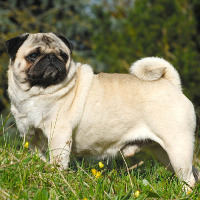
| The Pug was once considered Chinese royalty. He was a favorite of Chinese emperors and, as he moved out of the country through trade, the Pug became a favorite of royalty in other nations. The dog was named official dog of the House of Orange in Holland, and Marie-Antoinette owned a Pug before her marriage to Louis XVI. Queen Victoria, known for her love of dogs and her breeding program, adored the Pug breed. The Pug made its way to America after the Civil War and was first recognized by the American Kennel Club in 1885. | ||
 |
||
| Standard of the Pug |
A little of the Coton de Tuléar |
| The Coton de Tuléar originated on the island of Madagascar. It is related to the Bichon family of canines and looks very much like them. Nobody knows exactly how the dog came into being, but some believe it was a companion and ratter on merchant ships. Others claim the dogs are survivors of a shipwreck on the island. Whatever the case, the dog is very popular in its native land. Cotons were introduced to America in the 1970s, at the same time as a Frenchman brought Cotons back with him to France, where he continued to develop the breed. The breed is not yet recognized by the American Kennel Club, but it's important to remember that it's a fairly new breed. |
 |
| Standard of the Coton de Tuléar |
Appearance of the Pug-Coton |
| The Pug-Coton is a small dog. At maturity, it will weigh 9 kilos or less. Males and females are about the same size. Coloration will vary according to the dominant parental breed. It may be black, white, gray or brown. It can also be a combination of colors. His hair will normally be long, but he doesn't shed much. His long hair will be slightly wavy and silky, and can be as long as 10 centimeters. Often, the Pug-Cotton will have dark, black or brown markings on its ears, head and body. By the time the Pug-Cotton is an adult, these dark markings may lighten somewhat. It will be small in size, and without its hair, it may appear delicate and fragile. Its tail may curl over its back and have feathers on it. Feathering may also occur on the legs. |
Temperament of the Pug-Coton |
| The Pug-Coton is a friendly, cheerful little dog. He loves his family, from children to adults, and is very loyal to them. He's somewhat protective, although his small size doesn't always make him seem intimidating. He's very intelligent, so teach him a few tricks and keep toys that stimulate him mentally so he doesn't get bored or become destructive. He learns quickly and is very easy to train, however, it's advisable to start training as early as possible so that the Pug-Coton understands what you expect of him. He's gentle and doesn't mind being too active. A female Pug-Coton is likely to be more independent and stubborn than a male. Pug-Cotons are not for those who travel often or are away for hours at a time. They quickly form a bond with their human family and are prone to separation anxiety when left alone for long periods. |
Needs and activities of the Pug-Coton |
| The Pug-Coton is a rather laid-back dog. He doesn't need much activity. A short brisk walk or two a day is enough exercise for him. Again, he appreciates mental stimulation, and this can be provided by toys that engage his mind. Teach him tricks that exercise his mind too. A trip to the dog park also offers an excellent opportunity for exercise. Bear in mind that the Pug-Cotton may inherit the brachycephalic snout of its Pug parent. If this is the case, the Pug-Coton should never be overworked or overheated. Keep a little water on hand when you're out walking or playing in the park. |
Maintenance of the Pug-Coton |
| Pug-Cotton requires moderate maintenance. Its long hair should be brushed three or four times a week to avoid knots and tangles. It sheds very little throughout the year, a little more in spring and autumn when its coat changes. Although not considered hypoallergenic, it is a recommended breed for those fighting allergies, with experts recommending spending time with a Pug-Cotton just to be sure it won't provoke an allergic reaction. For easier maintenance, you can choose to shear your Pug-Cotton. Some simply keep his facial hair trimmed, and others keep it in a pretty topknot on his head. Bathe him if necessary. Tip: dry him rather than rubbing him with a towel to prevent him from sticking. Brush his teeth two or three times a week to prevent tartar build-up and bad breath. To prevent tooth decay, brush daily. Trim his nails every two or three weeks, provided he doesn't wear them out on his own. |



 English (United Kingdom)

Comments