
 |
Kurdish Shepherd Dog |
|
He is not recognized by the F.C.I. |
Origin |
Kurdistan | |
Translation |
Francis Vandersteen | |
En français, cette race se dit |
 |
Berger kurde |
Diese Norm ist in deutscher Sprache sichtbar |
 |
Kurdischer Schäferhund |
En español, esta raza se dice |
 |
Pastor Kurdo |
In het Nederlands, wordt dit ras gezegd |
 |
Koerdische Herdershond |
This breed is also known as |
Pshdar Dog
|
|
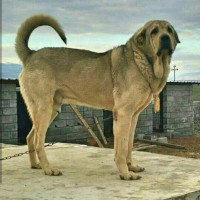
This dog is a very ancient breed of Kurdish shepherd dog, used to herd and protect Karakul sheep flocks from wolves, bears, and thieves. The history of its ancestors dates back to the 3rd millennium BCE, according to Assyrian and Babylonian clay tablets discovered in present-day Kurdistan. It is also used for hunting badgers and other game, as well as for guarding Kurdish villages. The exact origin of this dog is shrouded in mystery and legend, but some believe it descends from the Molossian dogs of Central Asia. The Kurdish Shepherd Dog is believed to have originated from the natural crossbreeding of ancient Turkish Kangal-type dogs with other molosser-type dogs that accompanied the caravans and nomads of the time. Its appearance is similar to that of the Turkish Kangal, with which it is often confused, but this Kurdish breed is lighter and more slender. It is worth noting that Kurds are not the only ones to own these dogs; many Turkish families also own them, although they rarely acknowledge their Kurdish origins due to the long-standing conflict between the two nations. The Kurdish Gammal is also one of the ancestors of the modern Anatolian Shepherd Dog, a breed often considered an imperfect Western creation. Although relatively unknown, the Kurdish Shepherd Dog exists in sufficient numbers and is highly valued by Kurds worldwide. Unlike its closest cousin, the Kangal, this robust working dog is not standardized and exhibits a wide variety of coat types and colors, ranging from short-haired to long and thick, and even, more rarely, some bearded specimens. Large, with a deep chest and well-developed musculature, the Kurdish Shepherd Dog is a resilient and athletic breed. The Psydar is a very powerful and intelligent dog, possessing a keen sense of security and a highly developed protective instinct. To channel this raw, natural strength, this breed requires proper training and a well-defined structure. Often used as a guard and herding dog, this powerful dog protects its property and owners by attacking any perceived threat. It is not advisable to let it roam freely in crowded environments. Loyal and obedient to its owner, it generally gets along well with children and other family members .Its head is round, with soft, slightly wrinkled skin, a prominent dewlap, a slightly elongated muzzle, and powerful jaws. The nose can be black, white, brown, or red. The ears were traditionally cropped, but this practice is becoming less common, and most dogs encountered today are not neutered. The tail can be docked or left natural and is usually carried high, reaching the waist. The most common colors were traditionally white, fawn, brown, blue, and black, but today, the majority of dogs are bi-colored. The average height is about 76 centimeters, although smaller specimens exist. |



 English (United Kingdom)

Comments