
 |
Kyi-Leo |
|
He is not recognized by the F.C.I. |
Origin |
U.S.A. |
A brief presentation of the Kyi-Leo |
| The Kyi-Leo is a new breed of dog recently recognized by the American Rare Breed Association. Inspired by an accidental cross between a Lhasa Apso and a Maltese in the 1950s, Harriet Linn began developing the breed in the late 1960s and in 1972 received the official name Kyi-Leo. These small dogs tend to be lively, friendly and attractive, without being prone to separation anxiety or destructive behavior. Like their parent breeds, they have a long coat of long hair rather than fur, which requires a lot of grooming, but is considered hypoallergenic due to its low shedding. |
History of the Kyi-Leo |
| When an accidental mating between a Maltese and a Lhasa Apso took place in California in the 1950s, the result was an adorable, good-natured little animal considered hypoallergenic due to its indented coat. The mix caught the attention of a woman named Harriet Linn, who purchased several of these little dogs between 1965 and 1969 to begin breeding them in earnest. In 1972, owners and breeders got together to formalize the breed and gave the companion dogs a name that paid tribute to their two fundamental breeds. Kyi is the Tibetan word for dog, a nod to the heritage of the Lhasa Apso, a small dog originally bred by Buddhist monks as a guard dog for their monasteries and prized for its audience and good judgment. Leo is the Latin word for Lion, alluding to one of the oldest and most heard nicknames for the Maltese breed dog, the Maltese Lion Dog. Although Kyi-Leo and Lhatese, the hybrid recognized by the Designer Breed Registry, share a common heritage, Lhatese can still have one or two purebred parents, Lhasa-Apso or Maltese, but Kyi-Leo has been recognized. as its own breed by the American Rare Breed Association and can only be the offspring of two registered Kyi-Leo dogs. Interestingly, the Kyi-Leo Club in Concord, California, has been naming Kyi-Leo as a breed since 1995. The breed name is described as breeding purebred dogs. |
Appearance of the Kyi-Leo |
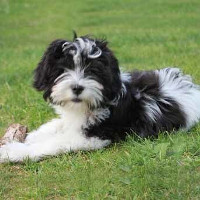
| Although these dogs are small in stature, they are generally well muscled with strong bones, making them quite sturdy for their stature, although they can be prone to leg or back injuries if they fall or attempt too ambitious a jump. They are longer than they are tall, with small, rounded skulls and straight, medium-length muzzles. Their prominent round black eyes are both gentle and alert, and their well-padded, mid-length ears hang like pendants from the sides of their heads. They have the same long, silky coat of their parent breeds, most often in white with black spots and markings, although some may have apricot, brown and even three-color markings instead, and their feathered tails fold over their backs. If not trimmed, the hair can hang over the face and mask the dog's eyes, but it rarely grows so long that it drags on the ground. |
Temperament of the Kyi-Leo |
| Kyi-Leo dogs are generally very lively dogs, attached to their families and sociable with other animals, but because of their Lhasa Apso heritage, they can be a little wary of strangers. This can usually be remedied by ensuring that your small dog is highly socialized, preferably at an early age. They are generally very gentle and have been described as difficult to provoke, so by temperament they may be perfectly suited to respectful older children, but due to their small size and somewhat fragile backs and legs, any interactions with smaller or more chaotic children should be closely supervised. They are generally active and playful at home, sometimes to the point of clownishness, and although they are generally attention-seeking, they have no tendency towards separation anxiety. They tend to follow instructions well and show a great deal of patience, although a few individuals show a certain stubbornness during training, especially when it comes to home training. |
Needs and activities of the Kyi-Leo |
| Although these tiny dogs are quite lively and energetic, they generally don't need much time to meet their exercise needs. While all dogs are happiest with a little time outdoors each day, indoor play can play an important role in a Kyi-Leo's daily activity, and they don't mind a reasonable amount of time alone. They make excellent companions in smaller spaces such as houses or apartments and, because of their acute hearing and alert nature, they also make admirable watchdogs. With traditional walks and lively games of fetch indoors, this breed would be well suited to competitive obedience and agility training. |
Maintenance of the Kyi-Leo |
| Like the two parent breeds, the Kyi-Leo has a long coat of silky hair rather than fur, making it a good choice for most allergy sufferers, but the coat requires a lot of grooming to keep it clean and tangle-free. The Kyi-Leo's coat is particularly prone to tangles and usually requires a long brushing session every day to avoid staining. Many Kyi-Leo owners learn to trim their dog's coat or choose to take their dog to the groomer regularly, usually every six to eight weeks. Although trimmed Kyi-Leo dogs still require daily grooming, it's a much simpler affair than when their coats are longer. As with all small dogs, teeth should be brushed several times a week. |



 English (United Kingdom)

Comments