
 |
Cane di Mannara |
|
He is not recognized by the F.C.I. |
Origin |
Italy (Sicily) | |
Translation |
Francis Vandersteen | |
This breed is also known as |
Pastore Siciliano
|
Usage |
| This is not a shepherd dog in the strict sense of the term, since in addition to grazing, Mannara have always been used as guard dogs in the annexes of the sheepfold and farmhouse. In the F.C.I. classification, Mannara would be classified in the 2nd group of mountain dogs. |
Brief historical summary |
| An ancestor of the Mannara dog has been present in Sicily since the Bronze Age, as evidenced by the discovery of bone finds in archaeological sites with a clear pastoral agricultural economy. Introduced by the Phoenicians in the 1st millennium BC during their frequent trade along Mediterranean routes, and a direct descendant of the Epirus Molossus. Traces of its presence can be found in Mamertini coins from the fourth century BC, depicting a mastiff dog guarding the temple at Adrano. It was later influenced by the Maghrebian dogs of nomadic Berber shepherds, imported to Sicily perhaps during the Carthaginian wars between the late 4th and early 3rd centuries BC, and again in 878 AD, during the Arab domination that influenced Sicilian agriculture for over two centuries. |
General appearance |
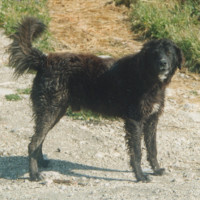
| The Mannara is a medium-sized dog that is hardy but never coarse, strong-built but always well-proportioned and never heavy; very marked sexual dimorphism; the general conformation is that of a mesomorph whose trunk is in the rectangle; harmonic in terms of size and disharmonic in terms of profile; a trunk that is about 10% longer than the height at the withers should not, however, appear low on the legs. It should give the impression of great ease of movement. Its hardiness and overall harmony should suggest a dog of old lineage. |
Important proportions |
| The length of the head must not exceed 3.6/10 of the height at the withers. The width of the skull is equal to its length. The length of the mouth is equal to 45% of the total length of the head. Rib height is equal to 50% of height at withers. The length of the body from the point of the shoulder to the point of the buttock is approximately 10% greater than the height at the withers. Thoracic circumference is at least 135% of height at withers. |
Behaviour / temperament |
| Used to guard sheepfolds and flocks, defending them from predation by foxes and stray dogs, as it once did from wolves. Docile towards family members. The safety of the animals entrusted to its care must be considered a breed characteristic. Undemanding, adapted for centuries to a poor diet of stale bread and milk processing waste. Very close to people, reserved but not independent, suspicious of strangers who constantly watch them, turning them over with disconcerting menace. At night, especially if in a pack, he becomes dangerous to intruders who might approach the sheepfold or property. All the social behavior of the species is unchanged. |
Head |
||
Cranial region |
||
Head |
The head is conical and moderately massive, broad and truncated, with slightly divergent facial skull axes; cephalic index no less than 53, skin adherent to underlying tissues, smooth and taut. | |
Skull |
The skull is large, its length equal to 55% of the total length of the head and its width almost equal to the length; forehead sufficiently developed but not so high that the frontal nose jumps abruptly but is obvious, pronounced furrow in the middle of the forehead, occipital crest not very obvious. | |
Facial region |
||
Nose |
The nose is voluminous, seen in profile, and should not protrude beyond the front of the muzzle. | |
Muzzle |
The muzzle is large, its lateral faces only slightly convergent, full, about 45% of the total length of the head. | |
Lips |
Dry, stretched lips; in males, the muzzle is fuller, but the lips never hang down, labial commissure visible. | |
Jaws and teeth |
Well-developed jaws and teeth; correct and complete dentition, pincer or scissor bite. | |
Eyes |
Relatively small in relation to the dimensions of the head and skull, neither protruding nor sunken; subfrontal position; iris color varies from honey to dark brown; well-fitting eyelids. | |
Ears |
The ears are not large in relation to the size of the skull, inserted higher into the zygomatic arch, worn at rest and for a third half-field, do not resemble collie ears; they may be cropped short by shepherds according to tradition and functional necessity. If not amputated, the shape is triangular with a blunt apex. | |
Neck |
| The length of the neck is at least 85% of the length of the head, broad and well connected to the shoulders, with a moderately arched upper profile, abundant hair; mane and collar present mainly in adult males; presents the giogaia, always well divided. |
Body |
||
Body |
Strongly built rectangular trunk, broad, muscular back, solid, straight line, no depressions, strong lumbar region well linked to the croup; obtuse angles on the hindquarters give the impression that the dorsal line rises slightly toward the croup, which should be rather broad and muscular, of good length, not sloping; well encircled, well developed three-dimensional thorax; broad, prominent chest; long, well sloping ribs; normally retracted stomach. | |
Tail |
| The tail is inserted on the extension of the hind line, large, long, full of thick hair; bent at rest, it is carried high, scimitar-like, when the dog is in attention. Its posture and insertion are characteristic of the breed. |
Limbs |
Forequarters |
||
Generality |
Forequarters with strong bone structure, well spaced at chest width. | |
Shoulders |
Relatively long shoulders with good slope. | |
Upper arm |
Upper arm about as long as shoulder. | |
Elbows |
Elbows well attached to the trunk, turning neither in nor out. | |
Forearm |
Forearm the same length as the upper arm, straight and strong. | |
Carpal |
Carpus in prolongation of the vertical line of the forearm. | |
Carpal joint |
Slightly open humerus angle of the scapula. | |
Pastern |
The metacarpus is not long and slightly bent. | |
Forefeet |
Round, compact feet with strong, thick pads. | |
Hindquarters |
||
Generality |
Strong, muscular hindquarters with strong, thick, moderate angulations. | |
Metatarsus |
Robust, dry metatarsus; the presence of dewclaws, single or double, should not be penalized. | |
Hind feet |
Feet like the front, but slightly oval. | |
Gait and movement |
| The typical movement of the Mannara is a loose, springy, relatively fast trot with strokes of speed. Good rider. |
Skin |
| Very thick skin, always well attached to the body except on the throat, where it forms a well-divided dewlap. |
Coat |
||
Hair |
Long, thick, compact hair that doesn't show through to the skin. Undercoat short on muzzle and front edges of legs, relatively long on ears. It is never completely straight, always slightly wavy, but can also be very wavy, or in broad curls, strong but not excessively hard. On the tail it is thick and rich, sometimes forming a slight fringe at its lower edge. The mane and collar are present, especially in adult males. | |
Colour |
Permitted : Fawn in all shades from mahogany to cream, black, Flea (luminous liver) with white distribution more or less extended to form patches or the so-called "monk" distribution (white patches on throat, chest, neck socks and tip of tail), brindle associated with the above colors, black and tan with the typical "black and tan" coat distribution without or with the presence of white (tricolor). | |
Size and weight |
||
Height at withers |
Male minimum 65 cm, female minimum 59 cm. Larger sizes are permitted only if the dog maintains agility and harmony without heaviness. |
|
Faults |
| • Any departure from the foregoing points should be considered a fault and the seriousness with which the fault should be regarded should be in exact proportion to its degree and its effect upon the health and welfare of the dog and its ability to perform its traditional work. • Faults listed should be in degree of seriousness. |
General faults |
 Monorchidism or cryptorchidism. Cowardice or extreme aggression. Short coat. Plain white coat. Monorchidism or cryptorchidism. Cowardice or extreme aggression. Short coat. Plain white coat. |
Important |
| This provisional standard is indispensable for the creation and implementation, on SAMANNARA's initiative, of an open herd book in which to register all subjects who will be considered as a whole, meeting the morphological type described and suitable for use in breeding selection to define the breed. Therefore, in this case, SAMANNARA limits itself to indicating, as elements that do not allow the admission of a general subject meeting the type to the establishment of an open herd book. |
NB : |
| • Any dog clearly showing physical or behavioural abnormalities shall be disqualified. • The above mentioned faults when occurring to a highly marked degree or frequently are disqualifying. • Male animals should have two apparently normal testicles fully descended into the scrotum. • Only functionally and clinically healthy dogs, with breed typical conformation should be used for breeding. |



 English (United Kingdom)

Comments