 |
Cane Fonnese |
|
He is not recognized by the F.C.I. |
Origin |
Italy (Sardinia) | |
Translation |
Francis Vandersteen |
Brief historical summary |
| This is an indigenous Sardinian breed that has been widespread throughout Sardinia since time immemorial. It was officially recognized in 2013. |
General appearance |
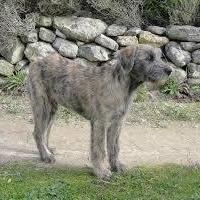
| Medium-sized dog, solid structure, powerful musculature, well-proportioned bone structure. The conformation is that of a mesomorph, with the trunk slightly longer than the height at the withers. Rough hair of varying length and color. Very agile, it moves with elegance and power at the same time. Dark, intense and disturbing. |
Important proportions |
| - The back is broad and long, about a third of the height at the withers. - The lumbar region blends harmoniously with the back. - The ribs are moderately broad, with a slightly encircled ribcage. - The thoracic circumference, measured at the elbows, is 25% higher than the height at the withers. |
Behaviour / temperament |
| Strong and decisive, with a tendency to dominate. Watchdog and guard dog, excellent guardian against possible predators (foxes or stray dogs), also very valuable as a hunting dog (wild boar), but patient with the animals he cares for. He must be treated as a true companion who can always be counted on, respecting his strong intelligence and dignity. He is wary of strangers but is tenderly obedient and affectionate with the owner. It's what's known as "a one-owner dog". Sometimes he communicates the presence of an intruder with a simple touch of his paw and a distinctive growl. Remarkable is his tendency, from the age of one month, to give his paw to his master as a sign of obedience, spontaneously, without any training. He was the inseparable companion of Sardinian bandits in their risky life in the bush. |
Head |
||
Cranial region |
||
Head |
Mesomorphic head, with well-detected occipital crest. The ratio of skull length to snout length is 1:1. | |
Skull |
The skull is slightly convex, with bizygomatic length equal to length. | |
Facial region |
||
Nose |
The large, fleshy, black nose, placed on the same line as the nasal reed, must be voluminous, with wide, open nostrils. | |
Muzzle |
The muzzle is of great power, with lateral faces converging slightly towards the nose. From the front, it appears as if written in a square. The lower limit of the mouth is given by the mandible. | |
Lips |
Lips should be well set and adherent, with pigmented mucous membranes. | |
Jaws and teeth |
Teeth are white, well developed, regularly aligned and complete in number. The canines are in opposition to each other (pincer bite), or the back of the canines of the jaw touches the front of the canines of the jaw (scissor bite). | |
Cheeks |
The zygomatic arches are obvious, and the frontal sinuses are not very pronounced. | |
Eyes |
The eyes of these dogs are very intense and characteristic, representing an element of breed typicity. The expression is somewhat sad, deep, authoritative, close, in a frontal position, with supraciliary arches of considerable development. The eye color is amber in all its shades, and the eyelids must be pigmented and firmly attached to the eyeball. | |
Ears |
The ears are triangular in shape, not too long (7-8 cm) above the bi-zygomatic arch, have pendants and, with care, adhere to the cheeks. | |
Neck |
| Vigorous, solid and muscular, of medium length, equal to about a third of the height at the withers, without dewlap, harmoniously linked to the shoulders and withers. |
Body |
||
Body |
The length of the trunk exceeds the height at the withers by 5-10%. | |
Topline |
Straight and level, with slightly pronounced withers. | |
Croup |
Strong and muscular, with a slope of about 15 degrees to the horizontal. | |
Chest |
The chest is moderately broad with well-developed muscles, and its width is closely related to the width of the ribs. The sternum is located at the scapulohumeral joint. | |
Tail |
| Inserted not very high, has a broad base, large at the root, robust, tapering progressively towards the end. Its length slightly exceeds the hock joint. At rest, it is shaped like a pump handle. It should never be carried straight, and when moving, it protrudes slightly beyond the line of the back. Some specimens may be born anuran or brachyuran. The tail can never be amputated. |
Limbs |
Forequarters |
||
Generality |
Strong and lean, straight, appearing in front and in profile. | |
Shoulders |
Shoulders with very strong musculature and 110-120 degree scapulohumeral joint. Firmly attached to the body. Strong, powerful, well-developed musculature. | |
Elbows |
Well-fitting elbows. | |
Forearm |
Forearm slightly longer than the upper arm, inclined at about 60 degrees to the horizontal. | |
Pastern |
Metacarpus moderately long and slightly inclined (approx. 10 degrees from vertical), presence of spurs. | |
Forefeet |
The feet are oval, with rounded toes and hard, resistant black plantar pads. Nails are always black and solid. | |
Hindquarters |
||
Generality |
Strong and muscular, with good appiombs, enough to give the image of power and agility. | |
Upper thigh |
Broad, flexed thighs (about 75 degrees from horizontal). | |
Lower thigh |
Moderately long and muscular. The patellofemoral angle is approximately 125/130 degrees. | |
Hock |
Long hock joint in proportion to leg length. Vertical, seen from behind, parallel to the median plane of the body. The tibio-tarsal angle is about 150 degrees. | |
Hind feet |
Compact, with hard, pigmented plantar pads. Strong, black nails. Presence of spurs. | |
Gait and movement |
| Agile and loose. At the trot, the hind leg gives considerable thrust and the forehead extends moderately. At the gallop, it moves with great agility, overcoming the roughness of the terrain in which it operates. |
Skin |
| Thick, well pigmented, adhering to all parts of the body, no dewlap on the neck. |
Coat |
||
Hair |
The hair is goat-like, with a thick, dense undercoat, 5-7 cm long, shorter on the legs, almost satiny on the muzzle, where it has rough tusks at the eyes and a beard on the chin. A short-haired variety is rare today. In males, the hair forms a mane on the neck. |
|
Colour |
The accepted colors are black, ash in its various shades, and honey. The latter can also be tabby, and is considered the oldest. | |
Size and weight |
||
Height at withers |
Males 56-60 cm, females 52-56 cm. | |
Weight |
Males 29-40 kg, females 25-32 kg. | |
Faults |
| • Any departure from the foregoing points should be considered a fault and the seriousness with which the fault should be regarded should be in exact proportion to its degree and its effect upon the health and welfare of the dog and its ability to perform its traditional work. • Faults listed should be in degree of seriousness. |
General faults |
 Overshot mouth. Lack of substance or overweight. White extremities. Depigmentation of palpebral and labial mucosa or nose. Heavy gait. Height less than or more than 3 cm above the maximum and minimum required by this standard. Tail rolled and bent over back. Depigmented nails. Overshot mouth. Lack of substance or overweight. White extremities. Depigmentation of palpebral and labial mucosa or nose. Heavy gait. Height less than or more than 3 cm above the maximum and minimum required by this standard. Tail rolled and bent over back. Depigmented nails. |
NB : |
| • Any dog clearly showing physical or behavioural abnormalities shall be disqualified. • The above mentioned faults when occurring to a highly marked degree or frequently are disqualifying. • Male animals should have two apparently normal testicles fully descended into the scrotum. • Only functionally and clinically healthy dogs, with breed typical conformation should be used for breeding. |



 English (United Kingdom)

Comments