
 |
Galician Pointer |
|
He is not recognized by the F.C.I. |
Origin |
Spain | |
Translation |
Francis Vandersteen |
A brief presentation of the Galician Pointer |
| An ancient breed, the Galician Pointer shares common ancestry with other better-known breeds, such as the English Pointer and German Shorthaired Pointer. As you might expect, the Galician Pointer is a hunting dog. Their specialty is using scent to find and retrieve game birds, such as partridge, woodcock and quail. An elegant breed, their athletic lines conceal a surprisingly robust mental attitude, meaning they're not afraid to dive into a gorse and are well prepared mentally and physically to work on rough terrain. Words like courageous, intelligent and docile are associated with the Galician Pointer. In the right circumstances, they can make an excellent family dog, provided they get plenty of exercise. The main problem is their powerful prey drive, which exposes other members of the fur family to the risk of predation. |
History of the Galician Pointer |
| The name Galician Pointer refers to the region in Spain, Galicia, where this breed originated. But getting to this point involves a long history dating back to the Romans. Going back dozens of centuries, when the Roman Empire expanded, they brought cattle with them. This included an ancient breed, a type of Bracco Italiano that accompanied the Romans on migration. These dogs became widely established in what is now France, Spain and even England. As Bracco Italiano types mixed with local dogs, strains with different characteristics emerged. Galicia being an area of forest, woodland and garrigue, the Galician Pointer has responded by adapting to present-day characteristics. Interestingly, other better-known breeds such as the German Shorthaired Pointer and English Pointer have similar origins. This is a little ironic, since in the 1970s, these more popular breeds were almost the undoing of the Galician Pointer. In the 1970s, an influx of these other breeds had a disastrous effect on the Galician Pointer. Cross-breeding, along with the declining popularity of the native breed, led to a dramatic drop in numbers. Only recently have real attempts been made to save the breed. Even now, Galician Pointer numbers are limited and, in some cases, the purity of their lineage is questionable. Let's hope that growing awareness of this underrated dog will lead to a resurgence in popularity. |
Appearance of the Galician Pointer |
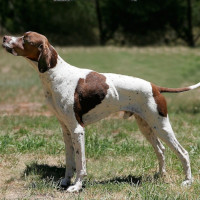
| If you have a picture of a Galician Pointer and have to guess what breed it is, chances are you can identify the Pointer in it. From their general silhouette to their coat color, Galician Pointers have much in common with their well-known cousins. Medium to large in size, they are perfectly suited to an active lifestyle. Their long legs are designed for endurance and sudden acceleration. Of course, they also have that inherent pointing instinct to put away a forepaw and point when they see something interesting. As with many working dogs, the Galician Pointer has a deep chest and plenty of lung capacity. Their snub waist and long legs suggest athleticism, as they do. The breed has a long nose, broad forehead and floppy ears that frame the face. Look into their eyes and you'll see willpower, intelligence and enthusiasm, which is also reflected in their active attitude. An interesting feature of the Galician Pointer is that the occasional puppy is born with a nasal cleft. This defined division in the center of the nasal planum gives them the appearance of having not one but two noses. This is not the case, since the internal nose is the same, but it's easy to understand how hunters centuries ago could think that these double-nosed dogs had superior scenting ability. This is a short-haired breed, which comes in a variety of colors. Most often, the base color is white, with patches of black, cinnamon, brown or orange. Tricolored layers with black or brown and tan cheeks are also seen, as well as solid layers of yellow, brown or black. |
Temperament of the Galician Pointer |
| The Galician Pointer is a true paragon of a dog, with words like obedient, willing, courageous and affectionate used to describe them. Through a working dog, they're never happier than when they're poking along following a scent trail. They are also delighted to find feathered prey, rabbits and hares to hunt. Indeed, once determined to follow them, the Galician Pointer is courageous and ignores the inconvenience of barberry thorns or brambles to capture their prey. |
Needs and activities of the Galician Pointer |
| The Galician Pointer's lean muscular lines strongly suggest their need for plenty of exercise. To be happy, this is a breed that needs plenty of exercise every day, with a chance to get out, sniff and explore. Failure to do so risks frustrating the dog, which could lead to antisocial behavior, such as barking, chewing or digging. |
Maintenance of the Galician Pointer |
| The Galician Pointer's short coat requires little maintenance. Like all dogs, they benefit from brushing at least twice a week. This massages the skin, spreads the natural conditioning oils over the coat and reduces shedding. In addition, regular grooming sessions help owners become familiar with what's normal for their dog, and then spot any new lumps or bumps that develop. |



 English (United Kingdom)

Comments