
 |
English Springerman |
|
He is not recognized by the F.C.I. |
Origin |
Great Britain <> Germany -> U.S.A. | |
Translation |
Francis Vandersteen |
A brief presentation of the English Springerman |
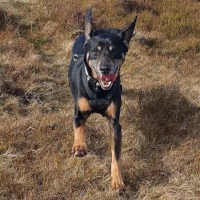
| The English Springer Spaniel and Dobermann mix, known as the English Springerman, is a gentle, wonderful breed of dog. They will be medium to large in size at maturity and have a lifespan of between 10 and 14 years. These dogs are friendly, intelligent and loyal, making them good pets that get on well with children. This hybrid breed can vary in appearance from parent to parent, and are relatively healthy dogs. The English Springerman is an active pet that will need a minimum of exercise, otherwise it has the potential to become destructive and develop separation anxiety. These dogs live well with active owners who can accompany them on outings. |
History of the English Springerman |
| The history of the English Springerman begins with the discovery of the parent breeds. These two dogs were recently bred together to create the English Springerman. |
A little of the English Springer Spaniel |
||
| The English Springer Spaniel was considered the same as the Cocker Spaniel until 1902, when they finally became their own breed. The larger dogs were used to hunt and flush larger game, and the smaller dogs hunted woodcock, hence the names of the different breeds. In the early 1900s, these dogs made their debut in the USA and Canada. The English Springer Spaniel Field Trial Association was formed in 1924 and was responsible for the breed's growing popularity. At first, the same dog could often be seen competing in the field as well as at shows, but eventually there was a separation between the field Springer Spaniel and the show Springer Spaniel. | ||
 |
||
| Standard of the English Springer Spaniel | ||
A little of the Dobermann |
||
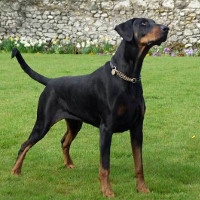
| The Dobermann is a dog created by a tax collector in Apolda, Germany. The man's name was Karl Friedrich Louis Dobermann. He meticulously bred dogs to create a mix capable of intimidating people and protecting him as he made rounds in dangerous neighborhoods. He had access to all kinds of dogs since he ran the local shelter. As Dobermann did not keep any documentation on breeding, it is not known with certainty which dogs were used to create the Dobermann. However, there is speculation that the Black and Tan Terrier, some shorthaired sheepdogs, the Rottweiler, the German Pinscher, the Beauceron, the Weimaraner, the Greyhound and the Black and Tan Manchester Terrier were all part of the dog's ancestry. The breed type was stabilized in 1899, and by the 1920s they had made their way to the USA, Europe, Russia and South Africa. | ||
 |
||
| Standard of the Dobermann |
Appearance of the English Springerman |
| The English Springerman will adopt the physical characteristics of both the English Springer Spaniel and the Dobermann. The sturdy, compact English Springer Spaniel is medium-sized, with a parallel topline of skull and muzzle. They have long ears and kind eyes, teeth that meet in a scissor bite and a broad but proportionate head. The neck will be about as long as the head, and the stop is moderate. These dogs carry their tails horizontally or slightly upwards, and are generally docked. Their fur is feathered. Dobermann dogs are also compact and very athletic. They have long, narrow heads and dark, almond-shaped eyes. It's common for these dogs to have cropped ears, but some owners choose to leave them natural. Tails are usually docked, and the body should be built squarely. |
Temperament of the English Springerman |
| The English Springerman's temperament will be similar to that of its parent breeds. The English Springer Spaniel is a cheerful, energetic dog that gets along with everyone, including children. This breed can also be good with other pets, although you should bear in mind that they were bred for bird hunting. For this reason, you need to keep an eye on them if you have a pet bird. They are too friendly and loving to be very good guard dogs, but they are very intelligent and like to please. They'll do their best in training, even if they can sometimes lose concentration. Always use positive reinforcement with these dogs. The temperament of the Dobermann can be a little confusing, as it varies from individual to individual. Some of these dogs are shy and reserved, but others can be outgoing and social. This breed is always loyal to its family, but how it mixes with other pets and its trainability will also depend on the individual dog. Unlike the other parent breed, these dogs are excellent watchdogs that won't attack intruders but pin them down instead. They can sometimes be prone to separation anxiety, especially if they don't get enough exercise. Your English Springerman will do its best if constant training and affection are maintained. |
Needs and activities of the English Springerman |
| The English Springerman can have a lot of energy to manage. If they don't get enough activity time, they'll chew and bounce all over the house. They need to be exercised both mentally and physically. They love activities such as flyball, tracking and agility. This hybrid is a high-energy dog that needs to be well exercised to avoid destructive behavior. They can get bored with repetition, so keep activities varied. |
Maintenance of the English Springerman |
| The time needed to care for your English Springerman will depend on the type of coat it inherits. Maintenance needs will vary from low to moderate. English Springer Spaniels should be brushed about three times a week. This will keep their fur shiny and free from knots and tangles. To keep them clean, you can trim the fur around their ears, tail, feet, head and neck. They should be trimmed about once every six to eight weeks. Some Spaniel owners choose to take their dogs to the groomer for trimming and bathing. The Dobermann is a low-maintenance breed that needs weekly brushing. They are clean and odorless, and won't need to be bathed often. You should also clean your dog's ears once a week to avoid infection, and trim his nails once or twice a month, although some very active dogs naturally wear down their nails and will need them less often. You should brush his teeth every day if possible, but two or three times a week is a minimum to keep gums and teeth healthy. |



 English (United Kingdom)

Comments