Sharbo

He is not recognized by the F.C.I.

Origin
China <> U.S.A. -> U.S.A.
Translation
Francis Vandersteen

A brief presentation of the Sharbo

The Sharbo is a hybrid of the Boston Terrier and the Shar Pei. This mix is interesting because it brings together two pure breeds that were originally bred specifically for bullfighting and dog fighting in their respective countries, the USA and China. This hybrid makes an excellent family pet if you're looking for loyal, affectionate companionship and a vigilant, protective watchdog. The Sharbo hybrid's parent, the Boston Terrier, was one of the first non-sporting breeds to be bred in the United States, and the first of a dozen American-bred breeds to be recognized by the American Kennel Club.

History of the Sharbo

The Sharbo is a hybrid of the Boston Terrier and the Shar Pei. Although there is no information concerning the date and place of origin of the hybrid itself, we can assume that it originated in the USA in the late 1900s and early 2000s, when interest in combining pure breeds increased for a variety of reasons. To better understand the Sharbo, let's take a brief look at the history of its parent breeds. The hybrid Sharbo itself is recognized by the American Canine Hybrid Club, the Designer Breed Registry, the Designer Dogs Kennel Club, the Dog Registry of America and the International Designer Canine Registry.


A little of the Shar Pei

        
The Shar Pei is a breed that, as its name suggests, originated in China and is a very old breed. There is not enough documentary evidence of dogs originating from China, so their approximate date of origin is very obscure. The Shar Pei was used by peasants in southern China for hunting, herding and protection, but the upper classes used it for a type of entertainment that has since been abolished and outlawed, namely pit-dog fighting. The Shar Pei breed virtually disappeared during the communist revolution and is now one of the rarest dog breeds. Today's Shar Pei is used as a pet and guard dog. It was officially recognized by the American Kennel Club in 1962 and is the 61st most popular breed on its register.
Standard of the Shar Pei


A little of the Boston Terrier

The Boston Terrier is a native of the United States, one of the first non-sporting breeds to be bred in the United States, and one of only 10 pure breeds recognized by the American Kennel Club as being bred in the United States. The Boston Terrier, also known as the “American Gentleman”, is thought to have originated in the 1800s, although the exact details of its origin vary, and, as its name suggests, it came from Boston, Massachusetts, at some point in the 1800s. The Boston's ancestors are thought to be Bulldogs, Terriers and possibly French Bulldogs. They were bred specifically for pit-dog fighting and bull riding, popular sources of entertainment at the time, but which have now been outlawed. Today, Boston Terriers are used as pets and guard dogs. The Boston Terrier was recognized by the American Kennel Club in 1893 and is the 21st most popular breed on its register.
Standard of the Boston Terrier

Appearance of the Sharbo

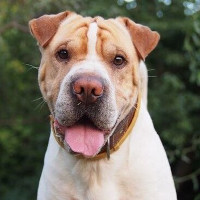
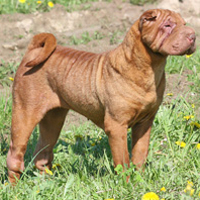
The Sharbo is a hybrid of the Boston Terrier and Shar Pei and, as such, may inherit appearance traits from one or both parent breeds. Breeders and owners describe the Sharbo as measuring between 38 and 51 centimeters and weighing between 13.5 and 22.5 kilos. It's a medium-sized dog with a sturdy body, square head, large, usually brown eyes and large, pointed, drooping ears, usually pointing downwards. Its coat is described as straight, short, rough or silky, the most common colors being brown, brindle, white, black and gold. Its tail can be of variable length, either very short and held close to the rump, or longer and curled over its back. Its bite is likely to be scissor-like, or weak enough that its muzzle is square, with a tongue that may be purple or black. Its feet may be small or medium-sized and compact, with short nails.

Temperament of the Sharbo

The Sharbo is a hybrid mix of the Boston Terrier and the Shar Pei, and can therefore inherit personality and temperament traits from one or both of its parent breeds. Sharbo breeders and owners describe its temperament and personality as gentle, playful and intelligent, but it also has aggression in its personality, especially when protecting its human family. He will probably be moderately gentle with children, early socialization being very important to ensure that he will adapt to children, strangers, the family cat and other dogs. He will be friendly and affectionate with his human family, loving your attention and giving you lots of his. He's pretty laid-back under normal circumstances and will be happy to run and play with you or just sit and cuddle on the sofa next to you. He can also be jealous of other dogs, or jealous when they get something he thinks he deserves or should have. These are traits that can be modified with proper socialization. He has a strong urge to hunt due to his hunting heritage from both parental breeds. It's important to remember this when he interacts with other dogs or animals. He will probably be wary of strangers until he understands that there is no danger to his human family. He'll probably be fairly easy to train, provided you can establish who's in charge from the outset. If you don't, you'll probably find yourself fighting him in almost everything he does.

Needs and activities of the Sharbo

The Sharbo hybrid is said to be constantly on the move. That said, you can expect him to have plenty of energy, which will need to be managed by 1-2 hours of exercise every day. This exercise can take the form of long daily walks, playtime in a dog park or fenced yard, interactive games like fetch, frisbee, fly ball, earth dog activities, obedience training and agility training. His hunting/prey instinct is strong, so be sure to keep him on a leash whenever he's outside the house, fenced yard or other secure enclosure, unless your daily exercise involves chasing him down the street, through the neighborhood or into the woods in pursuit of a small animal or unusual scent that has caught his attention. He's not an excessive barker, becoming verbal only when necessary, so he'll do well in an apartment or condo, unless there's a noise restriction in place. In the case of any type of accommodation, it's vital for his health and happiness that he gets proper exercise to avoid the destructive habits that can develop from boredom. They can live just as well in a family home, with or without a fenced-in yard, in an urban or rural setting. They are best suited to moderate or temperate climates, with extra protection and precautions required when temperatures are hotter or colder.

Maintenance of the Sharbo

Sharbo hybrids fall into the low-to-moderate maintenance category, with minimal shedding requiring only weekly brushing. Its coat is not hypoallergenic. Because of the Shar Pei parent's genetics, you may need to bathe it more often than other breeds. Recommendations for the Shar Pei are a bath every two weeks, and less often for the Boston. The Shar Pei parent also has a tendency to ear infections, which makes weekly ear checks very important. Be sure to clean them as needed with a cotton ball and an approved canine ear cleaner. Toenails should also be checked once or twice a month, and trimmed if necessary, unless he manages to keep them in place with his normal exercise regime. His teeth should be brushed at home at least two or three times a week to prevent the development of periodontal disease and accompanying tooth loss. The Shar Pei's genetics place it in a low category for drooling, but moderate for odor. This is a very active dog, which seems to move constantly, and will need 1 to 2 hours of daily exercise.

Comments

Latest page updates

  • Telomian

    Telomian He is not recognized by the F.C.I. Origin Malaysia Translation Francis Vandersteen A brief presentation of the Telomian The Telomian is a very rare breed of dog, and the only one native to Malaysia to have been bred outside the country. They were originally bred by the indigenous people of Malaysia to combat parasites such as snakes, rats,...
  • King Wheaten -- Cavalier King Charles Spaniel X Irish Soft Coated Wheaten Terrier

    King Wheaten He is not recognized by the F.C.I. Origin Great Britain <> Ireland -> U.S.A. Translation Francis Vandersteen A brief presentation of the King Wheaten The King Wheaten is a small dog with a heart this big and a playful disposition. Borrowing the energy and soft-coated waves of the Irish Soft Coated Wheaten Terrier and the size and...
  • Spanierd -- English Springer Spaniel X German Shepherd

    Spanierd He is not recognized by the F.C.I. Origin Great Britain <> Germany -> U.S.A. Translation Francis Vandersteen A brief presentation of the Spanierd The Spanierd is a hybrid dog. Its parent breeds are the English Springer Spaniel and the German Shepherd. They have an affable personality. He's known for entertaining family and friends with his...
  • Alaskan Goldenmute -- Alaskan Malamute X Golden Retriever

    Alaskan Goldenmute He is not recognized by the F.C.I. Origin U.S.A. <> Great Britain -> U.S.A. Translation Francis Vandersteen This breed is also known as Alaskan GoldenGoldenmuteAlaskan Gold Retriever     A brief presentation of the Alaskan Goldenmute The Alaskan Goldenmute is a descendant of two great dog breeds: the Alaskan Malamute and the Golden...
  • French pointing dog Pyrenean type

    French pointing dog Pyrenean type FCI standard Nº 134 Origin France Translation Mrs. Peggy Davis Group Group 7 Pointing Dogs Section Section 1.1 Continental Pointing Dogs « Braque » Type Working With working trial Acceptance on a definitive basis by the FCI Tuesday 18 January 1955 Publication of the official valid standard Tuesday 01 August 2023 Last...
  • French pointing dog Gascogne type

    French pointing dog Gascogne type FCI standard Nº 133 Origin France Translation Mrs. Peggy Davis Group Group 7 Pointing Dogs Section Section 1.1 Continental Pointing Dogs « Braque » Type Working With working trial Acceptance on a definitive basis by the FCI Monday 17 January 1955 Publication of the official valid standard Tuesday 01 August 2023 Last...
  • Vucciriscu

    Vucciriscu He is not recognized by the F.C.I. Origin Sicily Translation Francis Vandersteen En français, cette race se dit Vucciriscu Diese Norm ist in deutscher Sprache sichtbar Vucciriscu En español, esta raza se dice Vucciriscu In het Nederlands, wordt dit ras gezegd Vucciriscu This breed is also known as Sicilian Vucciriscu Sicilian Butcher...

© 2026 Groupe Milouchouchou ASBL. Tous droits réservés. En savoir plus

Protected by Copyright01
We use cookies

We use cookies on our website. Some of them are essential for the operation of the site, while others help us to improve this site and the user experience (tracking cookies). You can decide for yourself whether you want to allow cookies or not. Please note that if you reject them, you may not be able to use all the functionalities of the site.

Ok